Physical Address
304 North Cardinal St.
Dorchester Center, MA 02124

Physical Address
304 North Cardinal St.
Dorchester Center, MA 02124
Written By:
Reviewed By:

If you’ve ever heard someone say, “The Bhagavad Gita is a Hindu religious scripture, not really relevant to modern life,” you’re not alone. That’s probably the most common way the Gita is described—and also the most limiting one.
Here’s the truth, spoken by someone who has spent time actually listening to what the Gita is saying, not just reading it:
The Bhagavad Gita is far less interested in religion than it is in you—your confusion, your choices, your fear of getting things wrong, and your struggle to live a meaningful life.
Yes, it emerged from the Indian spiritual tradition. Yes, it features Krishna and Arjuna. But reducing the Gita to “just a religious book” is like calling a medical textbook a prayer manual simply because it mentions the human body. You miss the point entirely.
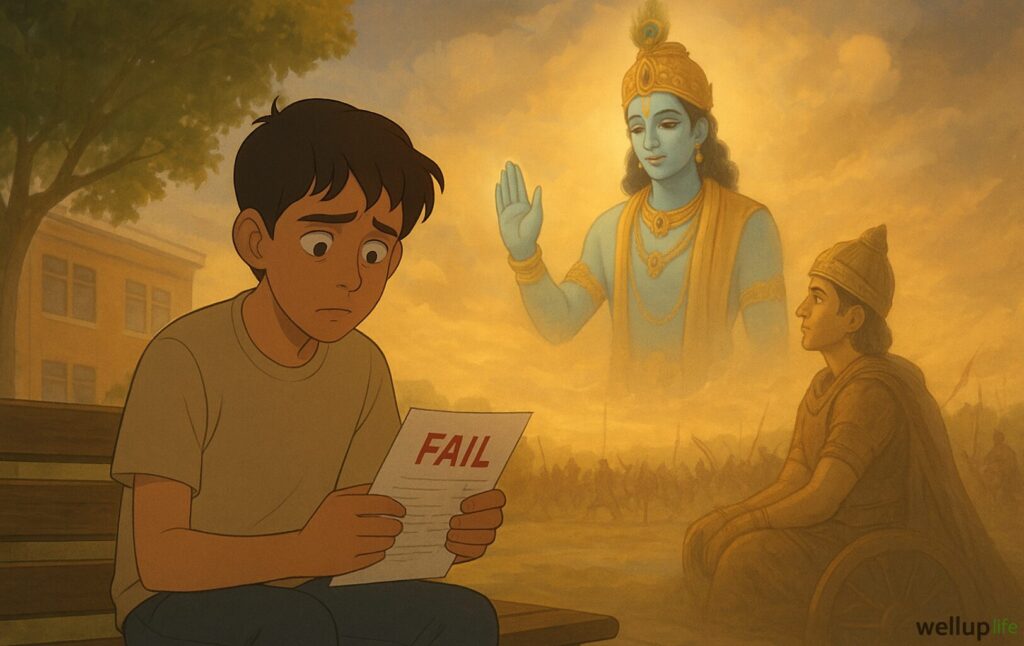
The Gita begins not in a temple, but on a battlefield. Not with worship, but with a man who is mentally overwhelmed, morally conflicted, and frozen by doubt. Arjuna isn’t asking how to be religious. He’s asking a question every human being asks at some point:
“What is the right thing to do when every option feels wrong?”
My mind is confused about my duty, and I have lost all composure.
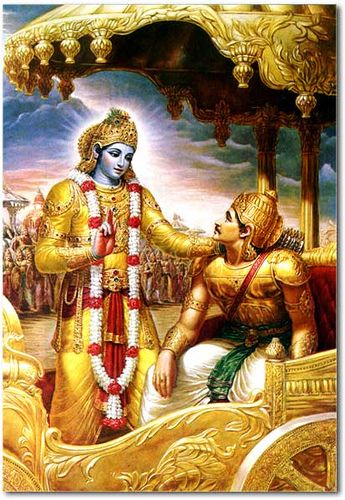 — Bhagavad Gita 2.7
That’s why the Bhagavad Gita has survived for thousands of years—not because people were told to believe in it, but because people recognized themselves in it. Its teachings aren’t about rituals, conversions, or blind faith. They’re about responsibility, action, inner discipline, emotional clarity, and learning how to live without being destroyed by fear, desire, or guilt.
In this article, we’re not going to treat the Gita like a sacred object kept behind glass. We’re going to talk about it as what it really is: a deeply practical guide to living consciously in a complicated world—whether you’re religious, spiritual, skeptical, or simply searching for clarity.
And once you see it that way, it becomes very clear why the Bhagavad Gita is not just a religious book at all.
Before we decide whether the Bhagavad Gita is religious or not, we need to pause and ask a simpler question—what do we usually mean by a “religious book”?
Most religious texts share a few familiar traits. They lay down fixed beliefs, establish clear rules of worship, define what is right and wrong through commandments, and often ask the reader to accept certain truths without questioning them. Their primary purpose is usually devotion—how to pray, whom to worship, what rituals to follow, and how to remain faithful within a particular tradition.
Now place the Bhagavad Gita beside that definition, and something feels off.
The Gita doesn’t begin by telling Arjuna what to believe. In fact, it does the opposite. Krishna doesn’t demand obedience or blind surrender. He listens. He allows Arjuna to speak, to doubt, to argue, to break down emotionally. The conversation unfolds not as a sermon, but as an exploration.
There are no instructions on rituals. No rules about temples, fasting, or ceremonies. No insistence that one path, one name of God, or one identity is superior to another. Instead, the Gita stays focused on something far more fundamental: how a human being should act when life puts them in an impossible situation.
Rather than offering commandments, the Gita offers frameworks. It examines duty, intention, attachment, and consequence. It asks why you act, not just what you do. It questions motivation more than morality and awareness more than obedience.
That’s why calling the Gita purely religious doesn’t quite work. It doesn’t try to create followers. It tries to create clarity.
You’re not told, “Believe this or else.”
You’re invited to see, reflect, and understand. Krishna even ends the dialogue by leaving the final decision to Arjuna—something almost unheard of in strictly religious instruction.
Do not simply follow tradition or authority. Reflect, understand, and then act.
— Bhagavad Gita 18.63 (paraphrased)This is the key difference. Religious books often aim to shape belief. The Bhagavad Gita aims to sharpen discernment. It functions less like a rulebook and more like a mirror—one that forces you to examine your responsibilities, your fears, and the inner logic behind your choices.
And that’s exactly why it slips out of the narrow category of religion and into something much broader: a philosophy of conscious living.
Once you stop looking at the Gita as a religious instruction book, its real purpose comes into focus. It isn’t trying to teach you how to worship. It’s trying to teach you how to live.
The central concern of the Gita is action—what to do when life demands a response from you. Arjuna’s crisis isn’t theoretical; it’s painfully practical. He must act, and not acting is also a choice with consequences. Krishna doesn’t give him an escape route through prayer or ritual. Instead, he addresses the inner confusion that makes action feel impossible.
This is where the Gita becomes deeply human. It talks about work, responsibility, skill, intention, and the emotional weight that comes with all of them. Whether you’re leading a team, raising a family, making ethical decisions, or simply trying to do your job without losing yourself, the Gita speaks directly to that experience.
You have the right to action, but not to the fruits of action.
— Bhagavad Gita 2.47One of its most powerful ideas is that meaningful action doesn’t come from avoiding the world, but from engaging with it intelligently. You are encouraged to perform your role fully, without being consumed by anxiety over outcomes. Success and failure are treated as experiences, not identities. What matters is the quality of awareness you bring to what you do.
Notice what’s missing here: instructions for ceremonies, external rules for purity, or a checklist for spiritual approval. The Gita assumes that life itself is the testing ground. Every situation becomes an opportunity to practice balance, responsibility, and inner steadiness.
In that sense, the Gita functions like a user’s guide for navigating complexity. It doesn’t simplify life into right and wrong answers. It teaches you how to stay centered when the answers aren’t clear—and how to act anyway.
That’s why people across generations keep returning to it. Not because it tells them what rituals to follow, but because it helps them move through life with clarity, courage, and composure when things are anything but simple.
If you strip away the symbolism and philosophical language, what’s left at the heart of the Gita is a remarkably accurate study of the human mind under pressure. Long before modern psychology named concepts like anxiety, avoidance, or emotional overload, the Gita was quietly observing them in action.
Arjuna’s breakdown isn’t spiritual weakness—it’s psychological paralysis. His body reacts before his mind can catch up. His thoughts spiral. His sense of identity collapses. He knows his duty, yet feels incapable of carrying it out. This isn’t a mythological problem. It’s what happens when emotion overwhelms clarity.
Krishna doesn’t dismiss these feelings, nor does he dramatize them. He addresses the mechanics behind them. The Gita explains how attachment intensifies fear, how unchecked desire clouds judgment, and how identification with outcomes creates inner instability. These aren’t moral failures; they’re patterns of the mind.
One of the text’s most practical insights is its emphasis on self-regulation. The mind, the Gita notes, can become your strongest ally or your biggest obstacle. Left untrained, it pulls you toward impulse, regret, and confusion. Guided with awareness, it becomes steady, focused, and resilient [1]Self-regulation plays a key role in emotional control and decision-making. This idea feels strikingly modern because it is rooted in observation, not belief.
The mind can be your best friend or your worst enemy.
— Bhagavad Gita 6.5–6.6The Gita also understands that emotional balance doesn’t come from suppression. You’re not asked to eliminate feelings, but to stop being controlled by them. By learning to pause, reflect, and act from understanding rather than reaction, inner chaos gradually loses its grip.
What makes this psychological framework so effective is its practicality. There’s no promise of instant peace or permanent calm. Instead, there’s a steady invitation to cultivate clarity moment by moment, especially when life feels overwhelming.
This is why the Gita continues to resonate in an age of burnout, stress, and constant mental noise [2]Chronic stress disrupts emotional regulation and cognitive function. It doesn’t diagnose you. It teaches you how to observe yourself—and in that awareness, regain control of your inner world.
One of the strongest reasons the Bhagavad Gita refuses to stay confined within a single religion is simple: it never asks you to change who you are in order to learn from it. There is no requirement to adopt a label, follow a lineage, or identify with a particular tradition before its insights begin to work.
The Gita speaks in terms of human experience, not religious membership. It addresses confusion, responsibility, attachment, fear, purpose—conditions that arise wherever there are people making choices in uncertain situations. That universality is intentional. The teachings are framed around inner development, not cultural belonging.
Even its view of the divine is surprisingly open-ended. Rather than insisting on one fixed image or form, the Gita acknowledges multiple ways of understanding reality—through action, knowledge, devotion, or disciplined awareness. None are presented as superior by default. The emphasis is on sincerity and understanding, not conformity.
This openness is why the Gita has been read, studied, and respected far beyond Hindu communities. Philosophers, leaders, artists, and thinkers across cultures have turned to it not as a scripture to be worshipped, but as a source of insight into human behavior and ethical living. Its appeal isn’t tied to geography or belief—it’s tied to relevance [3]Global influence and study of the Bhagavad Gita.
What makes the Gita truly universal is that it never positions itself as an authority demanding submission. It positions itself as a guide offering perspective. You are encouraged to think, question, and integrate what makes sense into your own life.
Whatever path people follow, I meet them there.
— Bhagavad Gita 4.11That’s a rare quality. Instead of drawing boundaries, the Gita dissolves them. Instead of telling you what you must believe, it helps you understand how to live with integrity—no matter where you come from or what you call yourself.
At first glance, an ancient dialogue set on a battlefield may seem distant from deadlines, relationships, and everyday pressures. But once you look closer, it becomes clear that the setting has changed—human conflict hasn’t. The Gita’s relevance lies in this continuity.
Modern life constantly places us in situations where we’re torn between options, expectations, and consequences. Career decisions, ethical compromises, family responsibilities, personal ambition—each one demands action, yet rarely offers certainty. The Gita doesn’t remove this uncertainty. It teaches you how to stand steady within it.
One of its most practical contributions is the idea of focusing on effort rather than obsession with results. In a world driven by metrics, validation, and comparison, this perspective feels almost radical. It reminds you that your control ends with intention and action; everything beyond that is influence, not ownership. This shift alone can reduce chronic stress and self-blame.
The Gita also speaks directly to burnout. It warns against defining yourself solely by success, failure, or external roles. When identity becomes fused with outcome, inner balance collapses. The pressure to constantly perform and succeed has been linked to rising burnout across professions [4]Burnout linked to chronic workplace stress. By grounding self-worth in awareness and responsibility rather than achievement, you gain the freedom to work hard without being consumed by the work.
Perform your duty with steadiness, abandoning attachment to success and failure.
— Bhagavad Gita 2.48Relationships, too, benefit from this understanding. The Gita encourages clarity without aggression, commitment without attachment, and compassion without self-erasure. It teaches how to stay present and principled, even when emotions run high or expectations clash.
Perhaps most importantly, the Gita offers a way to live meaningfully without withdrawing from life. You don’t need to escape society or renounce ambition to find peace. You learn to participate fully, while staying internally aligned.
That’s why the Gita fits so naturally into modern life. It doesn’t compete with your responsibilities—it helps you carry them with greater balance, clarity, and resilience.
We live in a time of constant input and very little reflection. Information is endless, opinions are loud, and pressure to “figure everything out” arrives early and stays late. In the middle of this noise, the Bhagavad Gita offers something quietly rare: a way to think clearly when certainty is unavailable.
Reading the Gita today isn’t about looking backward. It’s about gaining perspective that modern life often strips away. The text doesn’t promise quick fixes or motivational highs. It works at a deeper level, addressing how choices are made, how identity forms, and how inner stability can exist even when circumstances remain unsettled.
What makes the Gita especially relevant now is its refusal to polarize life into extremes. It doesn’t push you toward relentless ambition or total withdrawal. It shows how balance emerges from understanding your role, engaging sincerely, and staying aware of the mental traps that distort judgment. In an era that thrives on urgency and comparison, this approach is grounding.
The Gita also respects the reader’s intelligence. It doesn’t tell you what to think; it invites you to examine how you think. That alone makes it feel surprisingly modern. Each insight becomes more meaningful with experience, revealing layers rather than fixed conclusions.
There is nothing as purifying as knowledge gained through experience and reflection.
— Bhagavad Gita 4.38Reading the Gita today makes sense because it meets you where you are—confused, responsible, striving, and imperfect. It doesn’t demand belief. It offers clarity. And in a world that often feels overwhelming, that clarity is not just useful—it’s necessary.
If reading this article made you curious about the Gita, that’s a good place to be. The next step isn’t to rush out and buy any version you find—it’s to choose one that feels easy to sit with and understand.
The Bhagavad Gita isn’t a book you read quickly. It’s something you return to slowly, often at different stages of life. That’s why the version you choose really matters.
When buying the Gita online, don’t worry too much about the cover or how famous the publisher is. What matters most is the translation and explanation. If Gita has short and incomplete verses and a lack of clear explanation, then they can feel confusing or distant.
If you’re reading the Gita to understand it—not just to keep it on a shelf—look for a version that:
One edition many readers choose is Bhagavad-Gita As It Is by A.C. Bhaktivedanta Swami Prabhupada. It’s widely available online and presents each verse along with detailed explanations. If you like having guidance as you read and want to explore the philosophy more deeply, this version can be a good starting point.
That said, there’s no single version that works for everyone. Some people enjoy detailed commentary, while others prefer a lighter explanation that lets them form their own understanding. Reading reviews on sites like Amazon or Flipkart can help—you’ll often find honest feedback about clarity and readability.
You might also like a digital copy if you enjoy reading at your own pace. E-books make it easy to highlight lines, add notes, and come back to passages whenever you need them.
In the end, the “best” Bhagavad Gita is the one you’ll actually read. Choose a version that feels approachable, not heavy or intimidating.
And once you do, don’t treat it like a book you need to finish. Treat it like a conversation you can return to—especially when life feels confusing or uncertain.
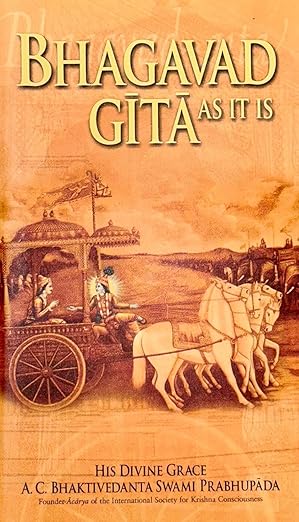
Category: Spiritual Wisdom, Philosophy, Mindfulness, Self-Improvement
Description: A widely respected edition of the Bhagavad Gita with Sanskrit verses, English translation, and commentary—guiding readers toward peace and self-realization.
Buy On AmazonWhen you step back and look at the Bhagavad Gita as a whole, its purpose becomes unmistakably clear. It isn’t trying to define a religion or preserve a tradition. It’s trying to cultivate awareness in the middle of life as it actually unfolds.
The Gita doesn’t separate inner growth from everyday responsibility. It weaves them together. Conscious living, as the text presents it, isn’t about retreating from the world or labeling experiences as spiritual or worldly. It’s about bringing clarity, intention, and balance into every action—especially the difficult ones.
A person who is steady in wisdom is unmoved by praise or blame.
— Bhagavad Gita 2.56What makes this philosophy enduring is its honesty. It acknowledges fear without feeding it, ambition without glorifying it, and doubt without condemning it. It recognizes that life will always involve tension, choice, and uncertainty. The work lies in how you meet those moments.
That’s why the Gita continues to speak across centuries. Not because it offers answers to every problem, but because it teaches a way of engaging with problems intelligently and ethically. It helps you live with purpose without becoming rigid, and with detachment without becoming indifferent.
Seen this way, the Bhagavad Gita stands as a guide for conscious living—one that remains relevant not through belief, but through understanding. And once you read it through that lens, it’s difficult to see it as merely a religious book at all.