Physical Address
304 North Cardinal St.
Dorchester Center, MA 02124

Physical Address
304 North Cardinal St.
Dorchester Center, MA 02124
Written By:
Reviewed By:

If you return to one idea from this article, let it be this:
You don’t need to win against your mind to find calm — you only need to stop fighting it.
Anxiety rarely comes from what’s happening right now.
It comes from the constant effort to control what might happen next — our thoughts, our emotions, the future itself.
Most advice tells us to fight anxiety. To silence the mind. To think positively. To stay strong.
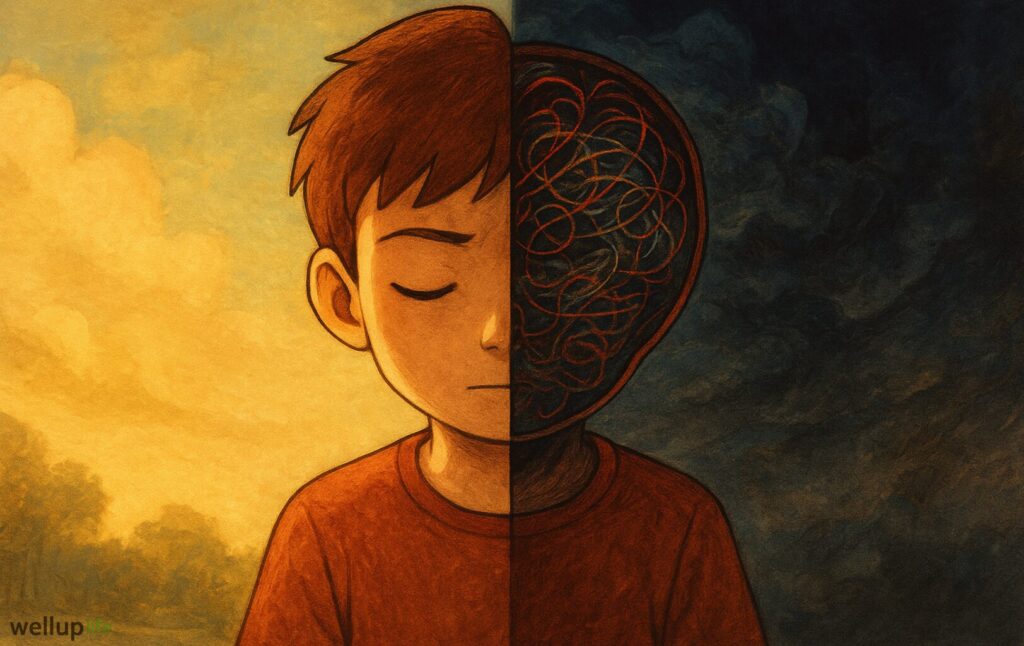
But anyone who has lived with anxiety knows this truth: the more you fight your mind, the louder it becomes.
This is where Stoicism offers a quieter, surprisingly compassionate approach.
Instead of battling anxious thoughts, Stoic philosophy teaches us how to step back from them — to see them clearly without being dragged into fear. Ancient Stoics like Marcus Aurelius understood something modern life often forgets: peace doesn’t come from controlling everything, but from responding wisely to what we can’t control.
In this article, we’ll explore how Stoicism can help you calm anxiety without suppressing emotions or forcing optimism. Not by fighting your mind — but by learning to work with it, gently and realistically.
Anxiety feels uncomfortable, so the instinctive response is to push it away. We try to distract ourselves, argue with our thoughts, or tell ourselves to “just calm down.” But paradoxically, this struggle is often what keeps anxiety alive.
Psychological research shows that suppressing or resisting unwanted thoughts can actually increase their intensity and frequency — a phenomenon often described as the rebound effect [1]Thought suppression can increase the recurrence of unwanted thoughts..
When you fight anxiety, your mind receives a subtle message: this feeling is dangerous. That judgment alone adds another layer of fear. Now you’re not just anxious about a situation — you’re anxious about being anxious. This creates a loop where the mind stays on high alert, constantly scanning for the feeling it’s trying to eliminate.
Ancient Stoic thinkers observed this pattern long before modern psychology named it. Epictetus taught that emotional distress does not come from events themselves, but from the judgments we attach to them — a principle summarized in his Enchiridion [2]People are disturbed not by things, but by the views they take of them..
An anxious thought like “What if something goes wrong?” isn’t the real problem. The suffering begins when the mind treats that thought as a threat that must be eliminated immediately. Neuroscience research supports this: attempts to control internal experiences often increase physiological arousal, keeping the nervous system in a heightened state [3]Experiential avoidance is associated with increased anxiety and emotional distress..
Stoicism doesn’t ask you to approve of anxiety or pretend it feels good. It simply asks you to stop treating it as an enemy. When anxiety is allowed to exist without resistance, it loses the fuel that keeps it intense. Calm arises not because anxiety disappears, but because the struggle with it ends.
This shift — from fighting to observing — is the foundation of how Stoicism helps calm anxiety naturally.
Long before anxiety was studied in labs or named in diagnostic manuals, Stoic philosophers were closely observing the human mind in daily life. What they noticed was simple but profound: the mind suffers more from its interpretations than from reality itself.
Stoicism teaches that events are neutral — they simply happen. Anxiety arises when the mind rushes ahead, predicting harm, loss, or failure, and then reacts as if those predictions are already true. In other words, the anxious mind doesn’t stay in the present moment; it lives in imagined futures.
The Stoics understood that this habit of mental anticipation is exhausting. Marcus Aurelius repeatedly reminded himself that distress comes not from what happens, but from the story the mind tells about what happens. In his personal reflections, he wrote that the mind has the power to withdraw from unnecessary disturbance [4]If you are distressed by anything external, the pain is not due to the thing itself, but to your estimate of it..
From a Stoic perspective, anxiety is not a flaw or weakness — it’s a misdirected survival instinct. The mind tries to protect you by preparing for danger, but without wisdom, this preparation turns into constant vigilance. Modern psychology echoes this view: anxiety is largely driven by threat anticipation rather than immediate danger [5]Anxiety is characterized by excessive anticipation of future threat..
Stoicism didn’t aim to eliminate thoughts or emotions. Instead, it focused on training judgment — learning to pause between a thought and the belief that it must be obeyed. When the mind learns that not every anxious thought deserves agreement, its grip naturally loosens.
This insight is crucial: Stoicism doesn’t calm anxiety by forcing the mind to relax. It calms anxiety by teaching the mind that it doesn’t need to react to every fear it imagines.
At the heart of Stoicism lies one simple distinction — and it’s one of the most calming ideas ever offered to an anxious mind: some things are in your control, and some things never were.
Stoic philosopher Epictetus taught that most human suffering comes from confusing these two. We try to control outcomes, other people’s reactions, future events, and uncertainties — all things fundamentally outside our power. When reality doesn’t cooperate, anxiety naturally follows.
Anxiety thrives on this mismatch.
You might worry about:
None of these are fully controllable. Yet the mind treats them as responsibilities. This constant mental overreach creates tension, vigilance, and fear.
Stoicism reframes the problem gently but firmly: you are not responsible for outcomes — only for your response.
Epictetus expressed this clearly when he wrote that some things are “up to us” and others are not, and peace depends on respecting that boundary.
From a psychological perspective, this idea aligns closely with modern findings. Research shows that anxiety increases when people attempt to control uncontrollable stressors, while focusing on adaptive responses reduces emotional distress [6]Perceived lack of control is strongly linked to anxiety and stress responses..
Stoicism doesn’t ask you to stop caring. It asks you to care wisely.
You can’t control whether anxiety arises — but you can control:
This shift alone reduces the pressure the mind places on itself. Anxiety softens not because life becomes predictable, but because the mind stops demanding certainty where none exists.
Understanding this distinction — control versus response — is what turns Stoicism from a philosophy into a daily calming practice.
One of the most misunderstood ideas about mental calm is the belief that peace comes from having better thoughts. Stoicism takes a different route. It teaches that calm comes from changing your relationship with thoughts, not from controlling their appearance.
The Stoics noticed that thoughts arise automatically. You don’t choose the first anxious thought — it appears on its own. But suffering begins when the mind immediately agrees with that thought and treats it as truth. Marcus Aurelius reminded himself that impressions are just impressions, and the mind always has the option to pause before reacting to them.
This pause is central to the Stoic approach. Instead of arguing with anxious thoughts or trying to replace them, Stoicism encourages observation without engagement. You notice the thought — “Something bad might happen” — without adding fear, urgency, or resistance. This simple act creates mental space.
Modern psychology supports this insight. Studies on cognitive defusion show that when people observe thoughts rather than identify with them, anxiety levels decrease [7]Viewing thoughts as mental events rather than facts reduces emotional distress..
Stoicism also emphasizes acceptance without surrender. Allowing a thought to exist doesn’t mean obeying it. It means acknowledging reality as it is in this moment, instead of fighting an internal battle. The Stoics believed that inner freedom begins when we stop demanding that the mind feel a certain way before we allow ourselves to live.
Another powerful Stoic practice is gently questioning anxious thoughts with reason:
These questions don’t suppress anxiety — they deflate its authority.
Over time, this approach retrains the nervous system. Anxiety may still arise, but it no longer dictates behavior or consumes attention. Calm becomes less about eliminating fear and more about moving forward without being ruled by it.
This is how Stoicism helps you calm anxiety — not by fighting your thoughts, but by refusing to let them decide who you are or how you live.
Stoicism doesn’t require long rituals or deep philosophical study. In fact, one of its most effective practices for anxiety is simple, quiet, and repeatable — something you can do in a few minutes each day.
The practice is called negative visualization, but despite the name, it isn’t about worrying. It’s about removing fear by facing uncertainty calmly.
Each day, preferably in the morning or evening, take two to three minutes and do the following:
Stoics like Seneca used this practice to reduce fear of loss and uncertainty. By mentally rehearsing challenges in a calm state, the mind becomes less reactive when uncertainty appears in real life [8]He robs present ills of their power who has perceived their coming beforehand..
Modern psychology mirrors this idea. Controlled exposure to feared thoughts — when done without resistance — reduces anxiety over time by teaching the brain that discomfort is survivable [9]Gradual exposure to feared situations reduces anxiety responses..
The key is consistency, not intensity. You’re not trying to feel calm immediately. You’re training the mind to trust its ability to respond — even when uncertainty exists.
Over time, this small daily practice weakens anxiety’s grip. Not because life becomes predictable, but because your confidence in handling life quietly grows.
At first glance, Stoicism and positive thinking might seem similar. Both aim to reduce distress and help you cope with life’s challenges. But for someone dealing with anxiety, the difference between them is crucial.
Positive thinking often encourages replacing negative thoughts with optimistic ones. While this can feel helpful in the short term, it can also create pressure. When anxiety returns — as it naturally does — the mind may interpret it as a personal failure: “I’m not thinking positively enough.” This can add guilt and frustration on top of fear.
Stoicism takes a different path.
Rather than asking you to think better thoughts, Stoicism teaches you to see the thoughts as they are. The goal isn’t optimism — it’s clarity. Stoics believed that peace comes from seeing reality as it is, not as we wish it to be.
Epictetus emphasized that freedom comes from aligning expectations with reality, not from forcing emotions to change. When you stop demanding that life feel safe at all times, anxiety loses much of its power.
Modern research supports this distinction. Studies show that emotional acceptance leads to lower anxiety and stress than attempts to suppress or replace unwanted emotions [10]Acceptance-based approaches are associated with reduced anxiety and psychological distress..
Another key difference is how each approach treats fear:
Stoicism doesn’t label anxious thoughts as “bad” or “wrong.” It simply refuses to give them authority. You can feel fear and still act with reason, values, and restraint. This is especially calming for anxious minds because it removes the constant pressure to feel a certain way before moving forward.
In short:
For anxiety, that stability often feels safer — and more sustainable — than forced positivity.
Anxiety often feels like a battle you’re supposed to win — against your thoughts, your emotions, even yourself. Stoicism gently dissolves that idea. It reminds you that peace doesn’t come from overpowering the mind, but from understanding it.
By learning what is and isn’t within your control, observing thoughts without obeying them, and responding to fear with reason instead of resistance, Stoicism offers a calm, steady way forward. Not by promising that anxiety will disappear, but by showing that you can live well even when it’s present.
This approach is especially powerful because it’s realistic. Life remains uncertain. Thoughts still arise. Emotions still fluctuate. But when you stop fighting your inner experience, the mind gradually relaxes. Anxiety loses its urgency — not because you defeated it, but because it no longer needs to be resisted.
Stoicism doesn’t make you emotionally numb. It makes you mentally free.
Read Next: How to Start Your Day Like a Stoic: Simple Morning Habits for Calm and Focus