Physical Address
304 North Cardinal St.
Dorchester Center, MA 02124

Physical Address
304 North Cardinal St.
Dorchester Center, MA 02124
Written By:
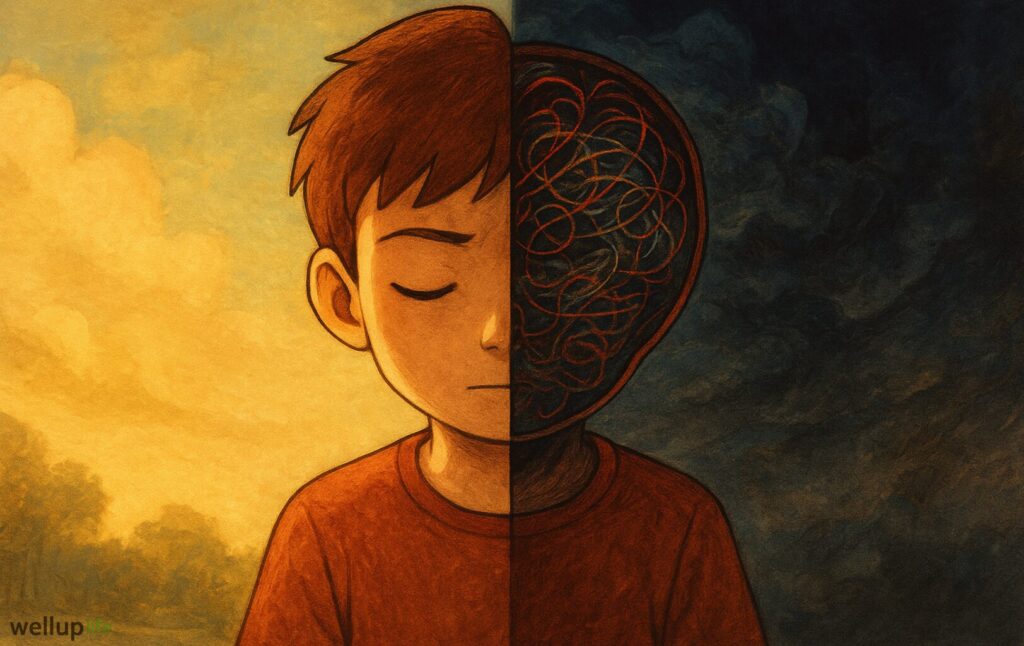
We’ve all been there — a heated argument, a harsh word, a moment when your heartbeat races, and logic fades away. Anger takes over so quickly that it almost feels like someone else is in control. But the truth is, that “someone” is your brain reacting in a way it has evolved to do for thousands of years.
Anger isn’t evil or unnatural — it’s a biological survival mechanism. It helps us protect boundaries, express pain, or respond to threats. The problem arises when that instinctive fire burns beyond control, damaging relationships, peace of mind, and even health.
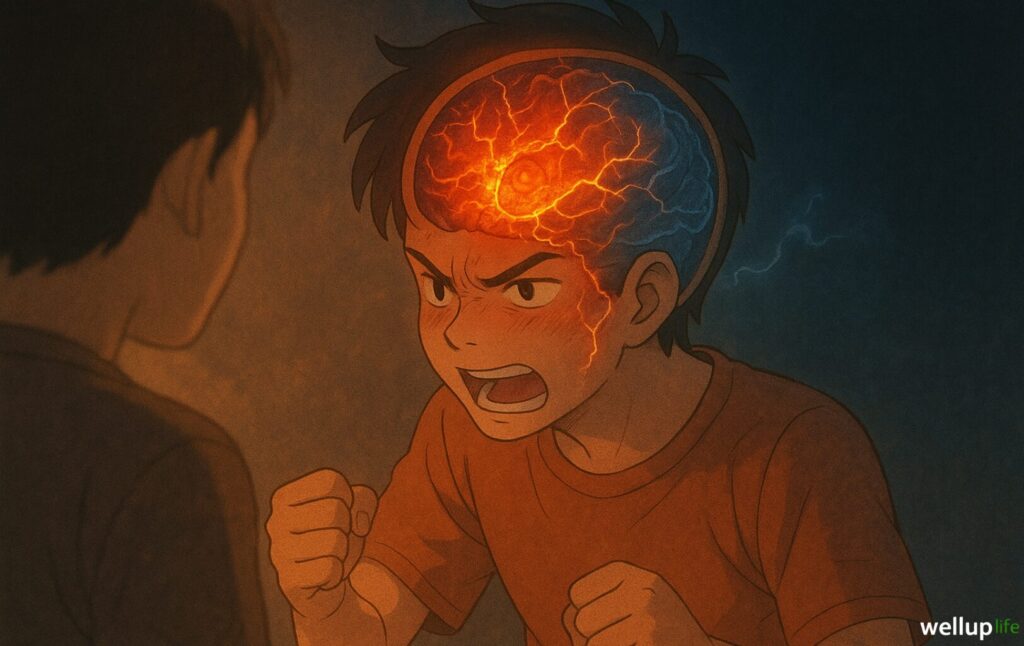
Recent neuroscience research shows that anger is not just an emotion — it’s a chemical and neural storm that hijacks your brain’s reasoning center [1]Harvard Health Publishing: The Nature of Anger. By understanding what happens inside your mind during conflict, you can learn to pause, stay aware, and respond consciously instead of reacting impulsively.
This article will explore the science of anger — what happens in your brain when conflict hits, why emotions sometimes overpower logic, and how both modern psychology and ancient wisdom offer ways to manage this fiery emotion gracefully.
When anger strikes, your brain doesn’t politely ask for permission — it reacts in milliseconds. The moment you perceive a threat, insult, or injustice, your brain’s emotional control center — the amygdala — jumps into action. Think of it as your internal alarm system.
The amygdala’s job is simple: protect you. It scans every situation for potential danger, just like it did for our ancestors facing wild animals. The problem? In modern life, it can’t tell the difference between a real threat and a harsh comment during an argument. So even a disagreement can trigger a fight-or-flight response.
Within seconds, your body releases adrenaline and cortisol, preparing you to fight or defend yourself. Your heart rate increases, breathing quickens, and muscles tighten — all signs that your body is getting ready for conflict.
Meanwhile, another important part of your brain — the prefrontal cortex — which handles logic, reasoning, and decision-making, goes quiet. The amygdala essentially hijacks your brain, pushing rational thought to the background [2]When emotions take over: Understanding the amygdala hijack. This is why, in the heat of the moment, you might say or do things that you later regret.
It’s not that you lose control — it’s that control temporarily shifts from your thinking brain to your emotional brain.
This is what scientists call the “amygdala hijack”, a term coined by psychologist Daniel Goleman. Understanding this process is the first step in mastering anger because it helps you see that your reaction isn’t moral failure — it’s biology.
The good news? Just as your brain can be hijacked by emotion, it can also be trained to stay calm through awareness and mindfulness. You can literally rewire how your brain responds to conflict — something we’ll explore in the coming sections.
When conflicts happen, it often feels as if your mind is on fire — logic disappears, words get sharper, and emotions take the driver’s seat. But the real question is: why does the brain overreact so strongly, even to small arguments?
The answer lies not just in brain chemistry, but in how the mind interprets threats and meaning.
Your brain evolved to protect you from harm. Thousands of years ago, that meant wild animals or physical attacks. Today, the “threats” are different — an insult, rejection, or disagreement. Yet the brain responds as if it’s still in survival mode.
When someone criticizes you or challenges your opinion, your brain perceives that as a danger to your identity or self-worth. The amygdala, which detects threats, doesn’t distinguish between a lion’s roar and a harsh tone from someone you care about. This confusion triggers an instant overreaction — what psychologists call “the emotional misfire” [3]Exposure to Criticism Modulates Left but Not Right Amygdala Functional Connectivity in Healthy Adolescents..
Our past experiences shape how we respond to conflict. If your brain associates certain tones, words, or gestures with past pain or humiliation, it’s more likely to react aggressively.
The hippocampus, the brain’s memory center, activates during conflict, recalling old emotional wounds and amplifying the current situation [4]Neural rhythmic underpinnings of intergroup bias: implications for peace-building attitudes and dialogue.
In short, you’re not just reacting to the present — you’re reacting to the echo of your past.
The ego — our sense of “I” — is deeply attached to beliefs, opinions, and self-image. When someone challenges them, it feels personal, even if it isn’t. The brain translates that challenge as a form of social threat, which studies show activates the same regions responsible for physical pain [5]The neural bases of social pain: Evidence for shared representations with physical pain.
This is why people often defend their opinions as fiercely as their lives — because, to the brain, it feels like survival.
During conflict, our mirror neurons make us unconsciously mimic the other person’s emotions. When someone raises their voice or becomes defensive, your brain mirrors that intensity, escalating the fight without conscious choice [6]Rizzolatti, G. & Craighero, L. (2004). The Mirror-Neuron System..
That’s why staying calm when others are angry feels so hard — your brain is wired to synchronize emotionally.
In essence, your brain overreacts not because you’re weak or irrational, but because it’s trying to protect you — from perceived emotional harm, rejection, or loss of control.
Recognizing this automatic wiring is the first step toward mastering it. Once you see that most anger begins as misinterpreted fear or hurt, you gain the power to respond with awareness instead of impulse.
When anger rises, it’s not just emotion — it’s chemistry in motion. Every feeling of rage, irritation, or frustration is powered by a surge of hormones and neurotransmitters that change how your body and brain function within seconds.
The moment your brain senses conflict, your adrenal glands release adrenaline — the body’s rapid-response hormone. It sharpens focus, speeds up your heartbeat, and sends energy rushing to your muscles.
That’s why you feel a sudden “rush” or heat when angry — adrenaline is preparing you for action, whether to argue, defend, or escape.
However, too much adrenaline can make you impulsive, pushing you to react before thinking. It shortens the gap between feeling and acting — one reason why anger can be so explosive.
Unlike adrenaline, cortisol stays longer in your system. It keeps you alert, tense, and on edge — useful in real danger, but harmful when triggered too often.
Chronic exposure to cortisol from repeated anger can lead to fatigue, poor sleep, and even weaken your immune system [7]American Psychological Association: Stress effects on the body.
It’s the reason people who stay angry frequently feel drained, anxious, or restless even after the conflict ends. The body stays chemically “stuck” in defense mode.
Surprisingly, anger doesn’t only feel bad — it can sometimes feel energizing or satisfying. That’s the work of dopamine, the brain’s reward chemical.
When you express anger, especially in arguments, you “win,” your brain releases a small hit of dopamine, creating a sense of control or relief [8]Association of Psychology Science: People Who Are Angry Pay More Attention to Rewards Than Threats.
Over time, this can become a subtle emotional habit — your brain starts associating anger with a feeling of power. That’s why some people unconsciously seek arguments or feel “better” after venting.
On the other side of this storm is serotonin, a neurotransmitter that promotes calm and emotional stability. Low serotonin levels are linked to impulsive aggression and irritability [9]National Library of Medicine: Role of Serotonin and Dopamine System Interactions in the Neurobiology of Impulsive Aggression and its Comorbidity with other Clinical Disorders.
Practices like meditation, deep breathing, and gratitude can help increase serotonin naturally — bringing balance back to your emotional chemistry.
After an anger episode, your brain and body enter a cool-down period. Hormones like cortisol slowly decrease, the heart rate returns to normal, and rational thinking begins to take over again.
But if anger episodes are frequent, your brain may start releasing these chemicals more easily — creating a loop where irritation becomes your default state.
Breaking that cycle starts with awareness — understanding that anger isn’t just emotional; it’s biological fuel that you can learn to regulate rather than suppress.
Anger doesn’t stay trapped in your mind — it ripples through your entire body. Every time you lose your temper, your brain sends a signal that alters your heartbeat, breathing, muscles, and even your immune system. Over time, this chemical chaos leaves a deeper mark on your health than most people realize.
When anger flares, your sympathetic nervous system switches on — preparing you to fight or defend. Your heart rate spikes, blood pressure rises, and breathing becomes shallow.
These reactions are helpful for quick bursts of energy but dangerous when they happen too often. Even brief anger episodes can temporarily increase the risk of heart strain [10]Journal of the American College of Cardiology: Outbursts of Anger as a Trigger of Acute Cardiovascular Events: A Systematic Review and Meta-Analysis.
That’s why people often feel hot, tense, or shaky after arguing — your body just went through a mini survival drill.
Occasional anger is normal. But when anger becomes constant — when you replay arguments, hold grudges, or live in irritation — it starts to harm your body silently.
Continuous exposure to stress hormones like cortisol and adrenaline leads to:
Research from Harvard Medical School found that people with chronic anger are more likely to suffer from cardiovascular issues and metabolic problems [11]Harvard Health Publishing: A brief bout of anger may be bad for your blood vessels. Your body isn’t built to stay in a state of alert all the time. When it does, it slowly breaks down.
Unresolved anger also affects mental health. It can increase anxiety, depression, and feelings of isolation. Neuroscientists suggest that when anger becomes a habit, it changes neural pathways, making the brain more reactive to future stress [12]Research Gate: Neural Correlates of Anger, Angry Rumination, and Aggressive Personality.
In simple terms, the more you practice anger, the better your brain gets at it. That’s why breaking angry patterns feels hard — your brain has learned to respond that way.
The opposite is also true. Practicing calmness, mindfulness, or compassion can literally rewire your brain’s response. Activities like meditation, yoga, and deep breathing activate the parasympathetic nervous system, which lowers heart rate and relaxes muscles.
Over time, this creates a more balanced hormonal state and a stronger connection between your mind and body.
Long before neuroscience discovered the amygdala or hormones like cortisol, Indian philosophy had already explored the nature of anger — not as a random emotion, but as a state of the mind clouded by ignorance and attachment.
In the Bhagavad Gita (2.62–63), Lord Krishna describes the chain reaction of anger:
“From attachment comes desire, from desire arises anger. From anger comes delusion; from delusion, the loss of memory; from loss of memory, the destruction of intellect; and when intellect is destroyed, one is lost.”
In just a few lines, Krishna outlines what modern psychology now confirms — that anger disconnects us from reason and pushes us into emotional chaos. What science calls the “amygdala hijack,” the Gita calls the loss of intellect (buddhi-nāśa) — the moment when clarity is replaced by confusion.
According to Vedanta and Buddhist teachings, anger doesn’t arise from others’ actions but from our own attachments — our fixed expectations about how people or life “should” be.
When reality doesn’t match those expectations, the mind resists — and that resistance takes the form of anger.
This mirrors what psychology calls cognitive dissonance — the discomfort of holding conflicting beliefs or unmet desires. Both perspectives agree: peace comes not from controlling others, but from mastering our inner responses.
The Buddha taught that anger is like holding a hot coal, intending to throw it at someone else — you burn yourself first. He emphasized mindful observation — noticing anger as it arises, without acting on it. This awareness weakens its power over time.
Modern mindfulness research supports this ancient insight, showing that observing emotions without judgment activates the brain’s prefrontal cortex — the very region that helps regulate emotional impulses [13]Neurobiological Changes Induced by Mindfulness and Meditation: A Systematic Review.
In Indian philosophy, the solution isn’t suppression but detachment (vairagya) — the art of seeing events without letting them disturb your inner peace. Detachment doesn’t mean indifference; it means acting wisely without emotional turbulence.
The Gita calls this state samatvam — equilibrium of mind. When you cultivate it, even conflict feels lighter because your peace no longer depends on external outcomes.
What neuroscience explains as regulating the prefrontal cortex, Indian philosophy calls self-mastery. Both paths lead to the same truth — awareness is the key to freedom from anger.
By observing the mind, you reclaim control from the emotional storm. By practicing compassion, you transform anger into understanding.
In essence, ancient wisdom reminds us: you can’t stop anger from arising, but you can stop it from ruling you. True strength lies not in suppressing fire, but in learning to carry it with calm hands.
Understanding anger is only half the journey — the real transformation happens when you learn how to stay grounded even when emotions rise. Calming the angry brain doesn’t mean suppressing feelings; it means creating space between stimulus and response.
Here’s how you can train your brain to find that space.
When you feel anger rising, don’t rush to speak or act. Take a short pause — even 5 seconds can help. This moment allows your prefrontal cortex (the rational brain) to re-engage and interrupt the emotional surge.
Neuroscientists call this practice response inhibition, a key function in emotional regulation [14]The Neural Bases of Emotion Regulation: Reappraisal and Suppression of Negative Emotion.
Try silently saying to yourself:
“I’m feeling anger, but I don’t have to become anger.”
That tiny self-awareness is enough to shift control back to you.
Your breathing is your emotional switchboard. When you’re angry, it becomes short and rapid, fueling the body’s stress response. Slow, deep breathing activates the parasympathetic nervous system, lowering your heart rate and calming the mind.
Try this:
This simple technique, known as coherent breathing, is shown to reduce cortisol and restore emotional balance [15]Brown, R.P. & Gerbarg, P.L. (2005). Sudarshan Kriya yogic breathing in the treatment of stress and anxiety..
Research shows that naming an emotion reduces its intensity — a process called affect labeling.
Instead of saying, “I’m angry,” say, “I’m feeling angry right now.”
That small change creates a distance between you and the emotion, activating logical brain regions and quieting the amygdala [16]Putting feelings into words: affect labeling disrupts amygdala activity in response to affective stimuli.
When you view conflict through a new lens, your emotional response shifts.
Ask yourself:
Even 10 minutes of daily mindfulness can strengthen the prefrontal cortex, improving your ability to stay calm under pressure. You don’t need a ritual — just sit quietly, observe your breath, and notice your thoughts without judgment.
Studies show that regular meditation reduces amygdala reactivity and increases emotional resilience [17]Tang, Y.Y. et al. (2015). The neuroscience of mindfulness meditation..
After an argument, take a few minutes to reflect, not replay. Write down what triggered your anger and how your body felt. This builds emotional awareness and breaks repeating patterns. Letting go doesn’t mean weakness — it’s an act of inner strength.
Compassion disarms anger. When you try to see the pain or fear behind someone’s behavior, it becomes easier to respond with understanding instead of hostility.
Similarly, gratitude rewires the brain to focus on what’s right rather than what’s wrong, lowering chronic irritation levels.
By practicing these habits, you teach your brain a new way of responding. Over time, the emotional storm that once ruled your reactions becomes a gentle wave you can ride with awareness.
Anger, when brief and purposeful, protects us — it signals when boundaries are crossed or when something needs to change.
But when anger turns into a constant background emotion — simmering beneath daily life — it becomes toxic. This toxic anger doesn’t just affect relationships; it quietly rewires your brain and damages your body over time.
Healthy anger is short-lived and followed by resolution. Toxic anger lingers — it’s resentment, bitterness, or passive aggression that never finds release.
Neuroscience shows that chronic anger keeps the amygdala overactive and weakens the prefrontal cortex, the area responsible for judgment and empathy.
Over time, your brain becomes wired for reactivity rather than reflection — meaning even small frustrations can feel unbearable.
When anger becomes a daily habit, your body lives in constant fight-or-flight mode.
Cortisol and adrenaline stay elevated, increasing risks of:
A study published in The Journal of Behavioral Medicine found that chronic anger and hostility significantly increase the risk of coronary heart disease [18]The association of anger and hostility with future coronary heart disease: a meta-analytic review of prospective evidence.
Your body isn’t designed to stay angry; it’s designed to act, calm down, and restore balance.
Toxic anger slowly isolates you. It pushes away loved ones, creates misunderstanding, and blocks empathy. When anger becomes your default mode, it replaces connection with control.
You may start to justify your anger as “being honest” or “teaching someone a lesson,” but in reality, it becomes a shield against vulnerability — the very thing that heals emotional wounds.
Unchecked anger doesn’t just express pain — it feeds it. Studies link chronic anger with increased anxiety, depression, and even substance abuse as people seek escape from the emotional intensity [19]Mediation effect of anger rumination on the relationship between dimensions of anger and anger control with mental health.
The more you indulge anger, the less space there is for peace or joy. Over time, your mind becomes conditioned to expect conflict instead of calm.
Toxic anger isn’t always explosive. Sometimes, it hides behind sarcasm, constant irritation, or silent resentment.
Ask yourself:
If these sound familiar, your anger may no longer be a signal — it’s become a cycle.
Recognizing that anger has become toxic isn’t weakness — it’s awakening. Once you see the pattern, you can begin to retrain your brain through calm awareness, compassion, and emotional regulation practices.
Remember, every time you choose peace over reaction, you’re rewiring your brain toward long-term emotional stability.
Anger is meant to protect, not poison. When transformed with awareness, even the darkest rage can become a teacher — revealing what still hurts and what still needs healing within us.
Anger is not our enemy — it’s a messenger.
It tells us where we feel hurt, powerless, or unheard. The real danger lies not in anger itself, but in our unawareness of it. When left unchecked, it hijacks our brain, floods our body with stress, and damages our peace. But when we understand it — biologically, psychologically, and spiritually — anger transforms from chaos into clarity.
Modern neuroscience shows that our brain can rewire itself toward calm through awareness and practice. Ancient Indian philosophy teaches the same truth in simpler words — control the mind before the mind controls you. Both paths meet at one point: awareness is freedom.
So the next time you feel that surge of heat inside, pause.
Breathe.
Observe.
Ask — what is this anger trying to teach me?
That small moment of reflection separates reaction from wisdom. It’s how the amygdala begins to quiet, and the prefrontal cortex — your seat of reason — takes charge again.
With time, you’ll realize that peace isn’t something you chase — it’s something you choose, moment by moment.
Anger, when understood, becomes strength — not destruction. It’s the same fire that can burn or illuminate. The choice, always, lies within you.