Physical Address
304 North Cardinal St.
Dorchester Center, MA 02124

Physical Address
304 North Cardinal St.
Dorchester Center, MA 02124
Written By:
Reviewed By:

In a world where constant pressure and endless comparisons cloud the mind, peace often feels like a distant dream. We work, chase goals, and scroll through distractions — yet inside, something still feels restless. The Bhagavad Gita, a timeless guide for human consciousness, offered a simple but transformative path thousands of years ago: Karma Yoga — the yoga of selfless action.
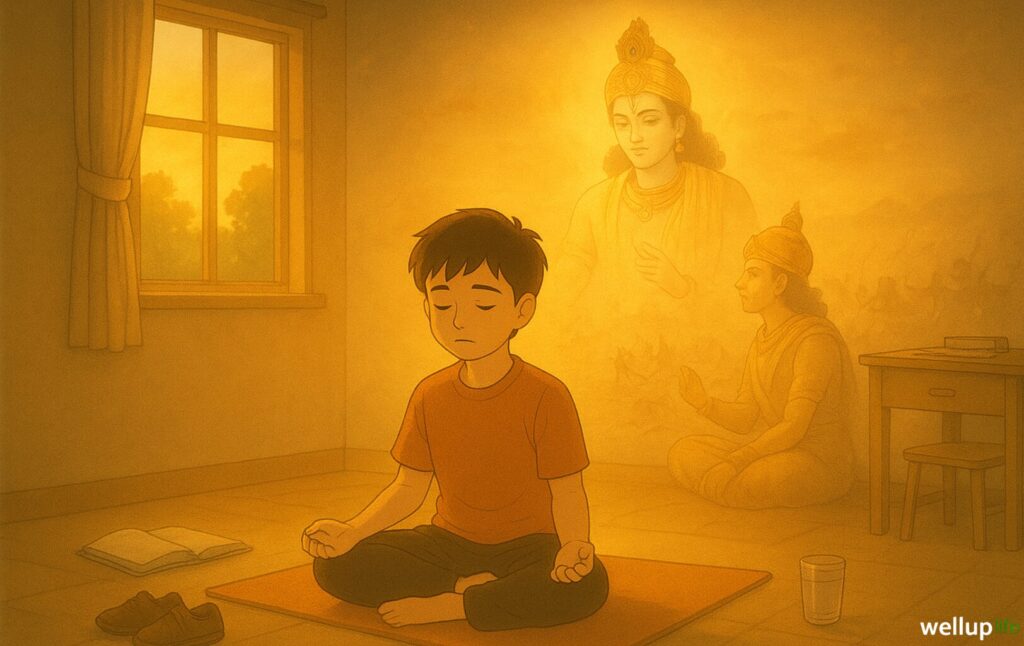
Karma Yoga teaches that peace doesn’t come from escaping work or isolating oneself; it comes from performing our duties with full attention, without attachment to the results. Lord Krishna’s wisdom to Arjuna wasn’t just a battlefield lesson — it was a blueprint for inner balance in moments of confusion, stress, and self-doubt.
Modern psychology, too, echoes this truth. Research shows that when we focus on the process rather than the outcome, we experience lower anxiety and higher satisfaction in our work and relationships. This mirrors what the Gita taught long ago — that inner peace is born not from control, but from surrendering the fruits of action.
As we explore Karma Yoga for mental wellness, we’ll uncover how this ancient philosophy aligns with modern life — helping us reduce stress, find meaning in work, and restore the serenity we’ve forgotten in the noise of the world.
Karma Yoga comes from two Sanskrit words — ‘Karma’, meaning action or deed, and ‘Yoga’, meaning union or discipline. Together, they form a philosophy that teaches how to act in the world without becoming trapped by it.
At its heart, Karma Yoga is the path of selfless action — performing one’s duties sincerely, without attachment to the outcome. In the Bhagavad Gita, Lord Krishna tells Arjuna:
You have the right to perform your prescribed duty, but you are not entitled to the fruits of action.
 — Bhagavad Gita 2.47
This verse captures the essence of Karma Yoga — do your best, and let go of the rest. It’s not about giving up effort or ambition; it’s about releasing the anxiety that comes from clinging to results.
Unlike Bhakti Yoga (the path of devotion) or Jnana Yoga (the path of knowledge), Karma Yoga doesn’t demand renunciation of the world. It’s a practice that invites us to live in the world — to work, serve, and love — but with inner freedom. It reminds us that spirituality isn’t found in withdrawal, but in conscious engagement with life.
Modern mindfulness teachings reflect this same wisdom. When we act with awareness, focusing on the task rather than the outcome, the mind becomes calm and centered. Studies show that practicing mindfulness during work can significantly reduce stress and improve mental clarity [1]The Effectiveness of Mindfulness-Based Stress Reduction on the Psychological Functioning of Healthcare Professionals: a Systematic Review'.
Karma Yoga, then, is not just a spiritual discipline — it’s a way of living with balance. It teaches us to act with love, accept with grace, and find peace not in what we achieve, but in how we act.
The Bhagavad Gita unfolds on a battlefield — not just of war, but of the human mind. Arjuna, a warrior and seeker of truth, stands torn between duty and despair. His heart is heavy with doubt, his mind clouded by emotion. In this moment of inner conflict, Lord Krishna reveals the timeless wisdom of Karma Yoga — the art of right action with a peaceful mind.
Krishna’s message to Arjuna was clear:
Be steadfast in yoga, O Arjuna. Perform your duty and abandon all attachment to success or failure.
— Bhagavad Gita 2.48This teaching carries the core essence of Karma Yoga — to act sincerely, yet remain undisturbed by the changing outcomes of life. True peace, Krishna explains, arises when we perform our roles with dedication, but without letting the results define our worth.
The Gita doesn’t ask us to renounce the world. Instead, it asks us to renounce attachment — the inner clinging that turns effort into suffering. When we act with awareness and surrender, our actions become a form of meditation. Every duty, whether small or great, becomes sacred.
Psychologists today describe a similar state known as the “flow state” — when the mind becomes completely absorbed in meaningful activity, free from self-centered thought or outcome anxiety. Studies show that individuals in flow experience greater emotional balance and satisfaction [2]Mihaly Csikszentmihalyi, M. (1990). Flow: The Psychology of Optimal Experience. Harper & Row..
Karma Yoga, as the Gita reveals, is therefore not about inaction — it’s about pure, mindful action. It transforms work into worship and duty into devotion. When we learn to give our best without demanding control over the result, the heart becomes light, and the mind serene.
This is the essence of the Gita’s teaching — freedom through action, not freedom from it.
Karma Yoga is not only a spiritual philosophy — it is also a profound psychological practice. It transforms the way we think, feel, and respond to life’s challenges. At its core, Karma Yoga teaches us to act without attachment, and modern psychology reveals why this mindset leads to emotional balance and inner peace.
When we attach our happiness to outcomes — success, recognition, or approval — our minds become restless. The fear of failure and the desire for reward create constant stress cycles. Psychologists call this the “hedonic treadmill”, where satisfaction fades quickly after achieving goals, leaving us chasing the next one [3]ResearchGate: Hedonic adaptation.'.
Karma Yoga breaks this cycle. By focusing on effort instead of outcome, we shift from external dependency to internal stability. Lord Krishna’s teaching — “Let your mind be undisturbed in success and failure” — reflects what psychologists today call equanimity, a state where emotional reactions are balanced and grounded.
Research in mindfulness-based therapies shows that practicing non-attachment reduces anxiety and enhances emotional regulation [4]Frontiers in Psychology: 'Letting Go of Self: The Creation of the Nonattachment to Self Scale'. This aligns perfectly with Karma Yoga’s principle of acting mindfully and releasing control over results.
Neuroscience also supports this timeless wisdom. When we detach from overthinking about rewards or failures, the prefrontal cortex — the part of the brain responsible for focus and decision-making — functions more efficiently. This helps us stay calm under pressure and make choices from clarity, not compulsion [5]Harvard Medical School: 'How meditation affects the brain'.
Thus, the psychology of Karma Yoga teaches that mental wellness is not achieved by escaping responsibility, but by transforming how we engage with it. Each action, done consciously and without expectation, becomes a step toward inner freedom.
In this way, the ancient wisdom of the Gita and modern science converge beautifully — both reminding us that peace begins not when life is easy, but when the mind learns to let go.
When practiced sincerely, Karma Yoga becomes more than a philosophy — it becomes a psychological therapy for the soul. It gently dissolves anxiety, overthinking, and emotional turbulence by teaching us to live with awareness and detachment. The Bhagavad Gita reveals that inner peace is not something we acquire; it’s something we uncover when we stop clinging to control.
Below are some of the most profound benefits of practicing Karma Yoga for mental wellness:
Most of our mental distress comes from attachment to the results of our actions — the “what ifs” and “what nexts.” Karma Yoga teaches us to act wholeheartedly and let go of expectations. This shift from control to surrender quiets the mind’s endless chatter.
Modern studies show that focusing on the process rather than the outcome lowers anxiety and enhances performance satisfaction [6]Learning to Enjoy the Process and Stop Worrying About the Outcome.
Life’s challenges are inevitable, but how we respond defines our peace. Karma Yoga trains the mind to remain balanced in both success and failure — a state known as samatvam in the Gita. Krishna calls this “Yoga of Equanimity”, where the mind stays stable regardless of external change.
Psychologists describe this as resilience, the ability to recover from stress without losing emotional grounding [7]American Psychological Association: 'Building your resilience'.
When we act without distraction or expectation, attention deepens naturally. Karma Yoga encourages complete presence in every action — whether studying, working, or helping others. This mindful engagement brings clarity and joy to even ordinary tasks.
Research shows that mindfulness practices increase focus and reduce mind wandering, leading to greater cognitive efficiency [8]Mindfulness Meditation: Impact on Attentional Control and Emotion Dysregulation.
Detachment in Karma Yoga doesn’t mean apathy — it means acting with love but without bondage. When we stop measuring our worth through outcomes, we create space for inner calm.
As Krishna says:
Peace comes to him who is free from desire and attachment, who has subdued the mind and senses.
— Bhagavad Gita 2.70This peaceful state reflects a mind that has learned to act with intention, not impulse — a cornerstone of emotional well-being.
Karma Yoga transforms even simple actions into acts of service. When we see our work as a contribution to the greater whole, life gains meaning. Psychologists affirm that people who act with purpose experience higher life satisfaction and better mental health [9]Purpose in Life and Associated Cognitive and Affective Mechanisms.
Through these benefits, Karma Yoga reveals that mental wellness doesn’t arise from escaping duties, but from infusing consciousness into every action. When we surrender results and focus on effort, we align with the flow of life itself — and in that alignment, the mind finds peace.
The beauty of Karma Yoga lies in its simplicity — it doesn’t require isolation, rituals, or renunciation. It can be practiced anywhere: in your study room, at work, in relationships, or while doing everyday tasks. Lord Krishna’s message to Arjuna was never about escaping action, but about transforming the mindset behind action.
Below are gentle, practical ways to live Karma Yoga each day:
Whatever your role — student, professional, parent, or creator — give your best to it. Karma Yoga teaches that the value of an action lies not in its size but in the consciousness you bring to it.
When you work with complete attention, the action itself becomes meditative.
Modern mindfulness research supports this idea: full engagement in daily tasks reduces stress and increases well-being [10]Harvard Health Publishing: 'How to reduce stress and anxiety through movement and mindfulness'.
This is the heart of Karma Yoga. You cannot always control the result, but you can always control the sincerity of your effort.
Krishna says:
To work alone you have the right, never to its fruits.
— Bhagavad Gita 2.47When you let go of the need for reward or recognition, you free your mind from anxiety. Detachment isn’t indifference — it’s emotional freedom.
Transform your daily work into a form of service — to others, to society, or simply to the divine within. This attitude dissolves ego and cultivates humility. Even small acts, when done selflessly, purify the heart.
Psychological research shows that altruistic acts — helping others without expectation — significantly improve emotional well-being and happiness [11]Help others—be happy? The effect of altruistic behavior on happiness across cultures.
Before sleep, gently reflect on your actions. Did you act consciously? Were there moments of attachment, pride, or anger? This reflection isn’t self-criticism — it’s awareness. Over time, it helps you act with more clarity and less emotional reaction.
The Gita calls this process svadhyaya, or self-study — a key to inner growth.
Whether you succeed or stumble, meet the outcome with equanimity. Every result is an opportunity — success teaches confidence, failure teaches humility.
Krishna’s wisdom reminds us that both pleasure and pain are temporary visitors. Acceptance brings freedom.
Modern cognitive psychology echoes this truth: acceptance-based coping leads to better emotional resilience and life satisfaction [12]Acceptance and Commitment Therapy and Psychological Well-Being: A Narrative Review.
Practicing Karma Yoga daily is not about perfection — it’s about presence. When every action becomes a conscious offering and every moment an opportunity for growth, life itself becomes spiritual practice. In this way, the ordinary turns sacred, and peace begins to bloom quietly within.
The wisdom of Karma Yoga isn’t confined to sacred texts or meditation halls — it breathes through ordinary moments and everyday actions. The Bhagavad Gita reminds us that true spirituality is not about escaping the world, but living within it with awareness, compassion, and balance.
In today’s fast-moving life, where pressure and performance often dictate our peace, Karma Yoga offers a practical path to work sincerely, love selflessly, and let go gracefully.
Imagine you’re at your desk, overwhelmed by deadlines or academic pressure. The mind rushes ahead — “What if I fail? What will others think?”
Karma Yoga invites a pause. It reminds you to focus only on the action, not the outcome.
When you give your best with sincerity — whether writing a report, coding, or studying — and let go of the results, you enter a state of flow where the mind is peaceful and focused.
Many successful individuals, from entrepreneurs to artists, unknowingly practice Karma Yoga by staying deeply engaged in their work, detached from fear or fame. They find joy not in reward, but in the doing itself.
Karma Yoga transforms relationships by teaching that love doesn’t mean control or expectation. When we love with attachment, we fear loss; when we love selflessly, love itself becomes freedom. Krishna’s wisdom reminds us: act with devotion, but don’t bind your happiness to another’s response.
Psychological studies show that secure, non-possessive love leads to deeper satisfaction and emotional stability [13]What Is Non-Attachment & Its 3 Benefits In Your Relationship.
True love, like true action, flows without demand.
Life constantly presents uncertainties — job rejections, misunderstandings, failures. The mind’s instinct is to resist, to fight, to worry. But Karma Yoga teaches us that every situation is a teacher.
When we act with calm effort and accept the outcome with grace, we turn obstacles into opportunities for growth.
As Krishna said,
Perform your duty, for action is better than inaction.
— Bhagavad Gita 3.8Even in the toughest storms, a Karma Yogi remains grounded, knowing that peace is not in control, but in surrender.
Serving others without expecting anything in return purifies the heart.
Mahatma Gandhi lived this principle deeply — his entire life was an expression of Karma Yoga. He once said, “The best way to find yourself is to lose yourself in the service of others.”
Modern research supports this truth: volunteering and helping others enhance happiness and reduce depression [14]Exploring the Effects of Volunteering on the Social, Mental, and Physical Health and Well-being of Volunteers: An Umbrella Review. Every act of kindness — a smile, a helping hand, or a word of encouragement — becomes sacred when done with pure intention.
Karma Yoga, when lived sincerely, transforms ordinary life into a spiritual practice. Whether in success or failure, joy or pain, it reminds us to act with awareness, serve with love, and surrender with faith.
The modern world may have changed, but the human heart hasn’t — it still seeks peace, purpose, and connection. And Karma Yoga, as Krishna revealed, remains one of the most timeless ways to find them all.
Over the years, Karma Yoga has been interpreted in many ways — some inspiring, others slightly misunderstood. In a world that often values productivity and reward, the deeper meaning of “action without attachment” can easily be lost.
Let’s clear a few common misconceptions that prevent people from fully experiencing its peace and power.
Some people assume that detachment means withdrawal — that if you don’t care about the results, you won’t put in effort. But Karma Yoga is not passivity; it’s pure action without ego.
Krishna never told Arjuna to abandon the battlefield. He told him to fight — but with clarity, without hatred or self-centered desire. Detachment doesn’t mean not caring; it means caring deeply without being enslaved by the outcome.
Psychologically, this approach fosters intrinsic motivation — the joy of doing something for its own sake rather than for reward [15]Self-determination theory and the facilitation of intrinsic motivation, social development, and well-being..
It’s easy to think Karma Yoga belongs only to spiritual seekers or ascetics. But the Gita was spoken on a battlefield, not in a monastery.
Krishna taught that one can be a Karma Yogi while working in an office, raising a family, or studying for exams. You don’t need to leave your responsibilities — you just need to shift your mindset:
Whatever you do, whatever you eat, whatever you offer or give away, do that as an offering to Me.
— Bhagavad Gita 9.27It’s a reminder that spirituality is not about where you are, but how you act where you are.
Some believe that detachment means giving up ambition or growth. But that’s not true. Karma Yoga doesn’t suppress your drive — it purifies it.
You can still dream, achieve, and create — the difference lies in your inner attitude. When success comes, you accept it humbly; when it doesn’t, you stay balanced. This balanced striving actually enhances performance and mental clarity, reducing burnout [16]Psychology Today: 'Why Detachment Is a Key Element to Success'.
Some think practicing detachment requires numbing emotions or pretending not to feel pain. But true Karma Yoga teaches emotional awareness, not denial.
It’s about acknowledging feelings — anger, joy, grief, or fear — without letting them control your actions. Krishna never told Arjuna to suppress emotion; he told him to rise above emotional confusion through wisdom and steady action.
Modern psychology supports this idea: emotional regulation, not suppression, leads to better mental health and resilience [17]APA PsycNet: 'Emotion regulation and well-being'.
Karma Yoga doesn’t erode or erase karma; it transforms the way you relate to it.
Through selfless action, your karma becomes lighter because it’s no longer driven by greed, fear, or ego.
As the Gita says,
One who performs their duty without attachment, surrendering the results to the Divine, is untouched by sin, just as a lotus leaf is untouched by water.
— Bhagavad Gita 5.10In this way, Karma Yoga doesn’t escape life’s responsibilities — it purifies them into a form of meditation.
When we clear these misconceptions, we realize that Karma Yoga isn’t about abandoning the world — it’s about transforming our relationship with it. It’s not about suppressing desire — it’s about awakening wisdom within desire. It’s not about renouncing action — it’s about acting from peace, not pressure.
The main principle of Karma Yoga is performing one’s duties with full sincerity and awareness, without attachment to the results. It’s about acting selflessly, guided by purpose rather than personal gain — as Krishna teaches in the Bhagavad Gita, “You have the right to work, but not to the fruits thereof.” (2.47).
Karma Yoga helps reduce stress and anxiety by shifting focus from outcomes to actions. When we detach from the constant need for validation and control, the mind finds peace. This mindset aligns with modern psychological concepts like mindfulness and intrinsic motivation, both of which are linked to better emotional balance and mental clarity.
Absolutely. Karma Yoga is not about rituals or belief systems — it’s a philosophy of living with awareness and compassion. Anyone, regardless of religion, can practice it by focusing on their work, doing it with sincerity, and letting go of attachment to success or failure.
You can begin with small, mindful actions — study with full attention, help someone without expecting recognition, or complete daily tasks with gratitude. The essence lies in doing your best and surrendering the rest. Even simple chores, when done with awareness, become acts of meditation.
They share a similar spirit but are not identical. Mindfulness focuses on being present and aware in each moment, while Karma Yoga adds a deeper spiritual dimension — acting with detachment and devotion. Together, they nurture a calm, focused, and compassionate mind.
Yes. By teaching non-attachment, Karma Yoga breaks the cycle of worry over results. This reduces mental clutter and helps us stay grounded in the present moment. Studies show that people who practice non-attachment experience lower anxiety and greater life satisfaction.
Karma Yoga focuses on selfless action, Bhakti Yoga emphasizes devotion and love for the Divine, and Jnana Yoga centers on wisdom and self-inquiry. The Gita teaches that all these paths ultimately lead to the same truth — inner peace and liberation — but Karma Yoga is often the most accessible for everyday life.
In a world that constantly measures worth through results, Karma Yoga offers a quiet revolution — a way to act with full devotion yet remain untouched by anxiety or pride.
The Bhagavad Gita reminds us that peace doesn’t come from escaping action, but from acting with the right intention.
When we focus on the purity of effort instead of the promise of reward, our mind begins to heal. Work becomes worship, relationships become sacred, and even challenges become teachers.
This is the essence of Karma Yoga — to act selflessly, live consciously, and surrender gracefully.
As Krishna said,
Yoga is excellence in action.
— Bhagavad Gita 2.50When our actions flow from peace, every moment — even the smallest — becomes a step toward inner freedom. And that is the true power of Karma Yoga: not to change the world outside, but to bring harmony within.