Physical Address
304 North Cardinal St.
Dorchester Center, MA 02124

Physical Address
304 North Cardinal St.
Dorchester Center, MA 02124
Written By:
Reviewed By:
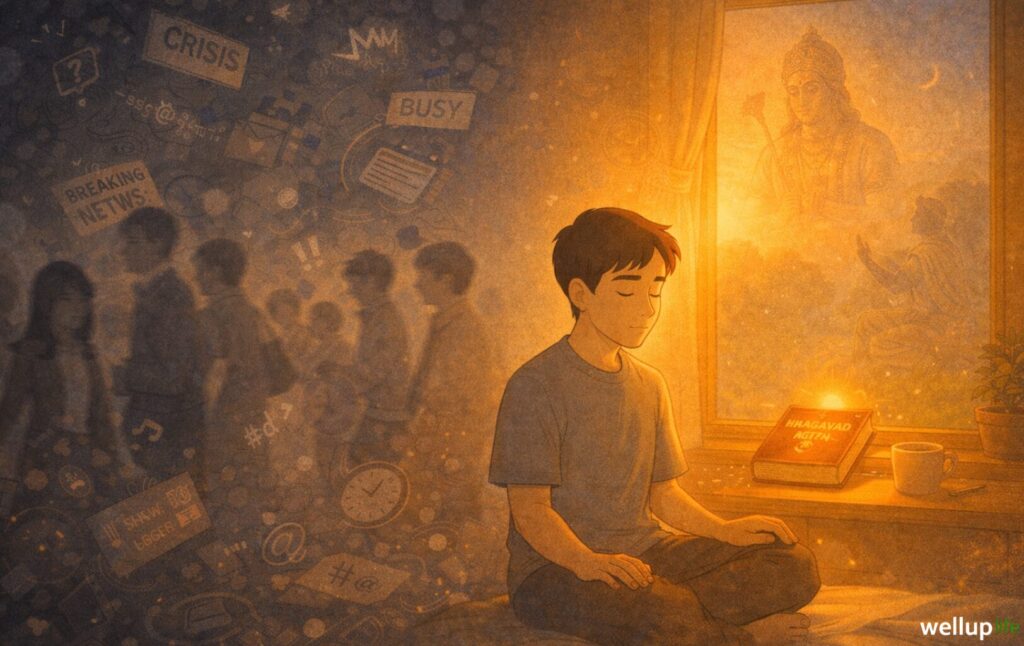
You know that feeling when you pick up your phone to check one thing, and suddenly it’s forty minutes later, and you’ve somehow spiraled through a doom-scroll of climate disasters, political arguments, and everyone else’s highlight reel?
Yeah, me too.
And now it’s midnight, your brain won’t shut up, and you’re lying there thinking about everything from that awkward thing you said three years ago to whether you’re doing enough with your life.
Here’s the thing: we’re all kind of drowning right now. Between the never-ending news cycle, the impossible standards we see online, work emails at all hours, and just… gestures vaguely at everything… It’s a lot. Some days it feels like the world is actively trying to stress us out. And honestly? It kind of is. Our brains weren’t designed for this much information, this much comparison, this much noise.
But here’s what I’ve been learning: people have been dealing with feeling overwhelmed for thousands of years. Obviously not about Instagram or Slack notifications, but about life, suffering, and how to find peace when everything feels chaotic. And some of the best insights? They come from Indian philosophy.
Now, before you click away thinking this is going to be some lecture about becoming a monk or sitting in the lotus position for hours, hold on. I’m talking about practical, weirdly relevant ideas that people figured out centuries ago that actually help with the exact stuff we’re struggling with today. No incense required (though it does smell nice).
In this article, I’m going to share some concepts and techniques from Indian philosophical traditions that have genuinely helped me feel less like I’m constantly drowning. We’ll keep it real, keep it simple, and focus on what you can actually use in your regular, messy, overwhelming life. Because honestly, we could all use a little more calm right about now.
Let’s be honest—something feels different about the way we’re stressed now compared to, say, twenty years ago. It’s not just that life is hard (it’s always been hard), but there’s this specific flavor of modern overwhelm that’s hard to put into words. You wake up already behind. You feel like you should be doing more, knowing more, being more. And somehow, despite having every convenience at our fingertips, we’re more anxious than ever.
Here’s what’s actually happening: our Stone Age brains are trying to function in a Digital Age world, and they’re basically short-circuiting.
Think about this: the average person today consumes about 34 gigabytes of information every day [1]Americans consume an average of 34 gigabytes of data and information each day. That’s roughly 100,000 words—the equivalent of a 300-page book. Every. Single. Day. Your great-grandparents might have encountered that much information in a month, or even a year.
We’re not just reading the news anymore—we’re getting breaking news alerts, push notifications, text updates, and hot takes from seventeen different sources before we’ve even finished our morning coffee. And our brains? They can’t tell the difference between a genuine threat and a stressful headline from across the world. So we’re walking around in a constant low-grade state of fight-or-flight, which is exhausting.
Then there’s social media, which has turned comparison from an occasional thing into a full-time sport. You’re not just keeping up with the Joneses next door anymore—you’re comparing yourself to everyone you’ve ever met, plus influencers, celebrities, and that girl from high school who apparently has her entire life together.
Research shows that the more time people spend on social media, the more likely they are to feel anxious and depressed [2]Multiple studies link heavy social media use with increased rates of depression and anxiety. But here’s the sneaky part: we know this. We know Instagram isn’t real life. We know everyone’s just posting their highlights. And yet, we still feel that pang of “why isn’t my life like that?”
Remember when work ended when you left the office? Yeah, that’s pretty much gone. Now we’ve got Slack messages at 9 PM, emails on weekends, and this weird guilt if we’re not “hustling” every spare moment. The boundary between work and life has gotten so blurry it’s basically invisible.
And it’s not just work—it’s everything. There’s always another email to answer, another chore to do, another self-improvement goal you should be working on. The finish line keeps moving, and we’re running ourselves ragged trying to reach it.
Here’s something our ancestors didn’t deal with: knowing about every crisis happening everywhere all at once. Climate change. Wars and conflicts. Pandemics. Political chaos. Economic uncertainty. Social justice issues. And we’re supposed to what? Just go about our day? Make small talk about the weather?
Here’s the thing: we can only know as much as we can meaningfully act upon. Our brains weren’t designed to carry the weight of every global crisis simultaneously. Yet that’s exactly what we’re trying to do. It feels impossible to hold all of that and still function—because it kind of is.
You scroll through your feed and within five minutes you’ve learned about a humanitarian crisis halfway across the world, political corruption in multiple countries, environmental disasters you can’t prevent, and injustices you feel powerless to stop. And then you’re expected to go make dinner, answer work emails, and act like everything’s normal.
This phenomenon—where we feel overwhelmed by global problems we can’t directly solve—creates what psychologists call a sense of helplessness. We care deeply about these issues (and we should), but we’re just one person with limited energy and resources. That gap between caring and being able to help? It’s mentally exhausting.
Mental health professionals recognize “headline stress disorder” as a real phenomenon, where constant exposure to global crises creates chronic anxiety[3]Exposure to constant negative news can lead to 'headline stress disorder' and increased anxiety. The result: you feel guilty for looking away, but overwhelmed when you look. You want to help everyone, but you can barely manage your own life. You care about everything, which means you’re carrying everything. And that’s simply not sustainable.
All of this adds up in our nervous systems. We’re living in a state of chronic stress that our bodies interpret as danger. Your heart rate stays elevated. Your cortisol levels are through the roof. You’re tired but wired, exhausted but can’t sleep, wanting to relax but unable to actually calm down.
The thing is, humans have always faced stress and uncertainty. But the specific cocktail of constant connectivity, information overload, social comparison, and global awareness? That’s new. We’re essentially running 21st-century software on hardware that hasn’t been updated in about 200,000 years.
Our stress response evolved to handle immediate, physical threats—like running from a predator. It wasn’t designed for:
And that’s exactly why looking back to ancient wisdom makes so much sense. Because while the circumstances are different, the fundamental questions—how do we find peace? How do we deal with things we can’t control? How do we live well amid chaos?—those are timeless. People thousands of years ago figured some stuff out. Maybe it’s time we listened.
Okay, so here’s where it gets interesting. While we’ve been inventing new ways to stress ourselves out, Indian philosophers were sitting under trees a few thousand years ago, asking questions like: “Why do we suffer?” and “How can we be at peace?” And somehow, their answers are weirdly perfect for our current moment.
I’m going to walk you through a few core concepts that have genuinely changed how I think about my own overwhelm. Fair warning: some of this might sound a little “out there” at first, but stick with me. Once you see how it applies to your actual life, it clicks.
Let’s start with maya, which is often translated as “illusion.” Now, before you think this is about to get too philosophical, it’s not saying the world isn’t real. It’s saying that our perception of things is often distorted, and we suffer because we believe our distorted thoughts are the absolute truth.
Think about it: How many times have you been stressed about something that never actually happened? You’re convinced your boss hates you because of one weird email. You’re sure everyone at the party thought you were awkward. You lie awake worrying about a worst-case scenario that has a 0.001% chance of occurring.
That’s Maya in action. Our minds create stories, worst-case scenarios, and entire narratives that feel completely real but are actually just our anxious imagination running wild. We’re getting stressed about things that literally don’t exist anywhere except in our heads.
The Indian philosophical take is this: most of what we think is permanent and solid is actually temporary and fluid. Your job title? Temporary. Your Instagram follower count? Meaningless. That embarrassing thing you said? Already forgotten by everyone except you. When you start seeing how much of your stress is based on illusions—things that aren’t real, aren’t permanent, or aren’t as important as they seem—you can let so much of it go.
Practical application: Next time you’re spiraling, ask yourself: “Is this thought based on facts, or is this just a story my anxious brain is telling me?” You’d be surprised how often it’s the latter.
Dharma is one of those Sanskrit words that doesn’t translate neatly into English, but think of it as your purpose, your duty, or your unique path in life. It’s about understanding what you’re meant to contribute and acting in alignment with that.
Now, I know “finding your purpose” sounds like something from a motivational poster, but hear me out. One reason we feel so overwhelmed is because we’re trying to do everything. We think we should be advancing our careers, maintaining perfect relationships, staying informed about every issue, having impressive hobbies, looking great, eating right, and somehow also being zen about it all.
The concept of dharma is actually liberating because it says: you don’t have to do everything. You have your specific path, your specific role, your specific contribution. Everything else? Not your circus, not your monkeys.
When you have clarity about what actually matters to you—not what Instagram says should matter, not what your parents think, not what would impress people—decision-making becomes so much easier. You can say no without guilt. You can let go of comparisons that don’t serve you. You can stop trying to be everything to everyone.
Practical application: Write down three things that feel most aligned with who you are and what you value. When you’re feeling overwhelmed by choices or obligations, check them against this list. If something doesn’t align with your core path, it’s okay to let it go.
Here’s where Indian philosophy gets really practical: Karma Yoga is the practice of acting without attachment to outcomes. Basically, you focus on doing your work well, but you stop obsessing over the results.
This was a game-changer for me because so much of my stress was about things I couldn’t control. I’d send an email and then refresh my inbox every two minutes waiting for a response. I’d have a difficult conversation and then replay it in my head for days, worrying about how it was received. I’d work really hard on something and then feel devastated if it didn’t turn out exactly as planned.
Karma Yoga says: do your part with full effort and integrity, but then release your grip on the outcome. You can’t control how someone responds to your email. You can’t control whether your project succeeds in the market. You can’t control what other people think of you. You can only control your own actions.
The Bhagavad Gita puts it beautifully: “You have a right to perform your prescribed duty, but you are not entitled to the fruits of action.”[4]Bhagavad Gita, Chapter 2, Verse 47 In other words, focus on what’s in your control (your effort, your intentions, your actions) and let go of what isn’t (outcomes, other people’s reactions, external results).
Practical application: After you’ve done something—sent the email, had the conversation, submitted the work—literally tell yourself “I’ve done my part.” Then consciously redirect your attention to something else. The outcome will unfold whether you worry about it or not.
What I love about these concepts is that they’re not asking you to become a different person or abandon your goals. They’re just offering a different lens for seeing your life. Most of your stress isn’t about what’s actually happening—it’s about your relationship to what’s happening.
Maya reminds you that your anxious thoughts aren’t facts. Dharma helps you focus on what actually matters. Karma Yoga frees you from obsessing over things you can’t control. Together? They create a framework for moving through the world with a lot less suffering.
And the beautiful thing is, people have been using these concepts to find peace for literally thousands of years. Long before smartphones and social media, humans were struggling with desire, fear, uncertainty, and the human tendency to make ourselves miserable. These ideas have stood the test of time because they address something fundamental about how our minds work.
Next up, we’ll get into the actual practices—the specific things you can do to start applying this ancient wisdom to your very modern overwhelm.
Alright, let’s get to the good stuff—the actual practices you can start using today. These aren’t complicated rituals that require special equipment or hours of free time. They’re simple techniques that have been helping people calm their minds for centuries, and they work just as well now as they did back then.
Pranayama literally means “breath control,” and before you roll your eyes thinking “oh great, another person telling me to just breathe”—stay with me. There’s actual science behind why this works.
When you’re stressed, your sympathetic nervous system (fight-or-flight mode) is running the show. Your breath becomes shallow and quick. Your heart races. You feel jittery and on edge. Controlled breathing directly activates your parasympathetic nervous system (rest-and-digest mode), which is like hitting the brake pedal on your stress response [5]Slow breathing techniques activate the parasympathetic nervous system and reduce stress.
The simplest technique to start: Alternate Nostril Breathing (Nadi Shodhana)
Here’s how you do it:
I know it sounds weird, but this takes maybe three minutes and genuinely works. I do this before stressful meetings or when I’m lying in bed with my mind racing. It’s like a reset button for your brain.
When to use it: Anytime you notice your thoughts spiraling, before bed, when you’re about to have a difficult conversation, or just as a daily practice in the morning.
Western meditation often focuses on “clearing your mind” or “thinking about nothing,” which, let’s be real, is basically impossible. Indian meditation practices like dhyana are actually more forgiving—they give your mind something to focus on rather than trying to force it to be blank.
The easiest entry point is mantra meditation. You silently repeat a word or phrase, and whenever your mind wanders (which it will, constantly), you just gently bring it back to the mantra. That’s it. You’re not doing it wrong when your mind wanders—bringing it back is the practice.
Simple mantra technique:
The goal isn’t to have some mystical experience. The goal is just to give your brain a break from its constant narrative. Studies show that even brief daily meditation reduces anxiety and improves emotional regulation [6]Regular meditation practice is associated with reduced anxiety and improved emotional regulation.
Real talk: Some days it’ll feel “good,” and some days your brain will be like a caffeinated squirrel. Both are fine. You’re still getting the benefits.
This one blew my mind when I first learned about it. Pratipaksha Bhavana comes from Patanjali’s Yoga Sutras (written around 400 CE), and it’s basically cognitive reframing—the same technique modern therapists use—except it’s almost 2,000 years old.
The concept is simple: when a negative or unhelpful thought arises, you consciously cultivate its opposite. Not in a fake, toxic-positivity way, but in a way that gives your brain an alternative track to run on.
Here’s how it works in practice:
Your brain says: “Everyone at that meeting thought my idea was stupid.”
Instead of spiraling into that story, you consciously think: “I shared an idea that I thought was worth discussing. Some people may have had concerns, and that’s okay. I contributed meaningfully to the conversation.”
Or: “I’m so behind on everything, I’ll never catch up.”
Opposite thought: “I’m doing what I can with the time and energy I have. Progress doesn’t have to be perfect to be real.”
Notice these aren’t delusional affirmations. You’re not telling yourself everything is perfect when it’s not. You’re just giving your brain a more balanced, compassionate narrative to work with instead of the catastrophic one it defaults to.
The practice: Keep a note on your phone where you track your common negative thoughts and their opposites. When you notice yourself spiraling, pull it out and deliberately shift your thinking. It feels awkward at first, but it genuinely rewires your thought patterns over time.
Santosha is one of the niyamas (personal practices) in yoga philosophy, and it means contentment. But it’s not about settling or giving up on goals—it’s about finding peace with where you are right now, even while you work toward something different.
This is huge for overwhelm because so much of our stress comes from constantly feeling like we’re not enough, don’t have enough, haven’t achieved enough. We’re always looking ahead to the next thing that will finally make us happy, and we miss the fact that our lives right now have good things in them.
The daily contentment practice:
Every evening, write down three things from that day that were enough. Not amazing, not Instagram-worthy—just enough. Maybe:
This isn’t about toxic positivity or ignoring real problems. It’s about training your brain to notice what’s actually okay instead of only focusing on what’s wrong or what’s missing. Research shows that regular gratitude practices significantly reduce stress and improve overall well-being [7]Gratitude practices are associated with reduced stress and improved mental health.
Important distinction: Santosha doesn’t mean you stop trying to improve your life. It means you stop making your peace conditional on getting to some future destination. You can be content and still have goals. You can appreciate where you are and work toward where you want to be.
Pratyahara is the practice of sense withdrawal—essentially, taking breaks from external stimulation so your nervous system can actually rest. In ancient times, this meant retreating from busy markets or social gatherings. Today? It means intentionally disconnecting from the digital fire hose.
Your senses are constantly being bombarded. Notifications. Screens. Background noise. Ads. Messages. Your brain never gets a break from processing external input, which is exhausting. Pratyahara creates space for your mind to just… be.
Digital Pratyahara practice:
Start with one “sense withdrawal” period each day:
You’ll probably feel some resistance to this (I certainly did). That resistance itself is informative—it shows how dependent we’ve become on constant stimulation. But once you push through it, the quiet becomes something you actually crave.
Here’s the thing: you don’t need to do all five of these practices to see a difference. In fact, trying to do everything at once is just another way to overwhelm yourself.
Pick one. Just one. The one that resonated most or seemed easiest. Do it for three weeks and see what happens. Once it becomes natural, you can add another if you want.
These practices aren’t about becoming some perfectly zen person who never feels stressed. They’re about giving yourself tools to come back to the center when life gets chaotic. And honestly? That’s enough.
Okay, so you’ve read about these practices and maybe you’re thinking, “This sounds great, but when exactly am I supposed to fit this into my life?” I get it. You’re already overwhelmed—adding more things to your plate, even good things, can feel like just another obligation.
Here’s the truth: these practices only work if you actually do them. And you’ll only do them if they fit into your real life, not some idealized version of your life where you have unlimited time and energy.
So let’s talk about how to actually make this work without turning it into another source of stress.
Seriously, smaller than you think you need to. We tend to get all excited about new practices and go big: “I’m going to meditate for 30 minutes every morning and do pranayama three times a day and journal every evening and—”
Stop. That lasts about three days before life happens and you fall off the wagon.
Instead, pick one practice and commit to the absolute minimum version of it. Not the optimal version. Not the “if I were a better person” version. The version you can do even on your worst days.
Examples:
That’s it. Do that one tiny thing every day for 21 days. Not because 21 days magically creates a habit (that’s actually a myth), but because three weeks is long enough to see if this practice genuinely helps you without feeling like an endless commitment.
Once something becomes automatic—like brushing your teeth, you don’t even think about it—then you can layer on something else if you want. But not before.
The easiest way to remember a new practice is to attach it to an existing habit. Behavior researchers call this “habit stacking,” and it works because you’re not relying on motivation or memory—you’re using the momentum of something you already do automatically.
Examples:
The key is making it so automatic that you’d feel weird not doing it, like how it feels weird if you forget to brush your teeth.
This is huge: you’re not trying to become enlightened. You’re not competing for most zen person of the year. You’re just trying to feel a little less overwhelmed.
Some days, your meditation will feel calm and peaceful. Other days, your brain will be a chaotic mess, and you’ll spend the entire five minutes thinking about your grocery list. Both count. You still showed up. That’s what matters.
The Indian philosophical traditions actually talk about this—it’s called abhyasa, which means consistent practice over time, even when it’s imperfect. Progress isn’t linear. Some days will feel like breakthroughs, and others will feel like you’ve forgotten everything. That’s completely normal.
Let’s be realistic: even with regular practice, you’re going to have days where everything falls apart. The deadline hits, the fight happens, the bad news comes, and suddenly all your calm goes out the window.
For those moments, have a simple emergency protocol. Write it down and keep it somewhere you can easily find it (I have mine in my phone notes). Something like:
When I’m spiraling:
You’re not trying to fix everything in that moment. You’re just trying to stop the spiral and bring yourself back to baseline. That’s enough.
You don’t have to create a separate “practice time” for everything. A lot of these concepts can layer into your existing routines.
Already go for walks? That’s moving meditation—try doing it without headphones sometimes and just notice what’s around you (pratyahara).
Already a journal? Add one line about practicing santosha—what was enough about today?
Already have a commute? Use part of it for pranayama at red lights or mantra repetition (silently, so people don’t think you’re weird).
Already see a therapist? Pratipaksha Bhavana is basically what they’re teaching you anyway—you’re just learning the ancient Sanskrit name for it.
The point is to weave these practices into your life, not to create some separate “spiritual practice” time that feels disconnected from everything else.
I know, I know—tracking things can feel like homework. But here’s why it helps: when you’re having a rough week and feel like nothing is working, you can look back and see that you actually have been doing the practice. Evidence helps when your brain is telling you you’re failing at everything.
Keep it dead simple. I use a habit tracker app where I just tap a circle each day I do my practice. Takes two seconds. Or just put a check mark on your calendar. The goal isn’t to create a perfect streak—it’s just to have a record that yes, you’re showing up, even when it doesn’t feel like it.
Not if you fall off. When. Because you will, and that’s fine.
Life happens. You get sick. You travel. You have a crisis. Suddenly, it’s been two weeks since you did any practice, and you feel guilty about it, which makes you avoid starting again, which makes the guilt worse…
Stop that spiral right now. Here’s what you do: just start again. Today. This moment. Don’t wait until Monday or the first of the month or “when things calm down.” Those are just excuses your brain uses to stay comfortable.
Missed two weeks? Doesn’t matter. Start with your tiny version today. The practice doesn’t care that you took a break. It’s still there waiting for you.
In the Indian philosophical traditions, they talk about this too—falling and getting back up is part of the path. It’s not failure. It’s literally how everyone does this.
Sometimes the changes are subtle, and you might not notice them until you look back. Here’s what you might observe after a few weeks:
It’s not dramatic. You’re not going to become a completely different person. But these small shifts? They compound. And over time, they change how you move through your days.
Here’s what all of this is actually about: you’re training yourself to have a different relationship with your own mind. Not to control it perfectly, not to never feel stressed, but to have tools that help you not get completely swept away by every thought and feeling.
Ancient wisdom isn’t ancient because it’s old. It’s ancient because it worked well enough that people kept passing it down for thousands of years. These practices have helped countless people navigate uncertainty, loss, fear, and chaos.
Your overwhelm might look different from theirs did—they didn’t have smartphones or social media—but the underlying human experience is the same. We all struggle with suffering. We all want peace. We all need practical tools that actually help.
You’ve got them now. Start small. Be patient with yourself. And trust that showing up, even imperfectly, is enough.
Here’s something they don’t tell you about working on your own inner peace: it doesn’t just affect you. It changes everything around you too.
I used to think that personal calm was, well, personal. Like it was this private thing I was doing for myself that didn’t really matter to anyone else. But Indian philosophy has this concept called Vasudhaiva Kutumbakam—which translates to “the world is one family”—and it’s based on the idea that we’re all fundamentally interconnected. Not in some abstract, woo-woo way, but in a very real, observable way.
When you’re less reactive, the people around you become less reactive. When you bring calm into a room, the temperature of that room changes. Your inner state isn’t contained inside you—it radiates outward, whether you realize it or not.
Think about the last time you were around someone who was really stressed out. Maybe they were frantic, snapping at people, radiating anxiety. How did you feel? Probably tense, right? Even if their stress had nothing to do with you, you could feel it.
That’s because emotions are contagious. Scientists call this “emotional contagion,” and research shows that we unconsciously mirror the emotional states of people around us [8]Emotional contagion occurs when people unconsciously mimic and synchronize with the emotions of others. If you’re in a room with someone who’s anxious, your nervous system starts to match theirs. But here’s the beautiful flip side: calm is contagious, too.
When you do your breathing practice before a tense family dinner, you’re not just helping yourself stay centered—you’re bringing a different energy to the whole situation. When you pause before reacting to your partner’s stress, you create space for them to calm down too. When you respond to a coworker’s panic with steady presence, you become an anchor in the chaos.
You don’t even have to say anything about it. Your calm becomes available to others just by being in the room.
One of the most practical ways this shows up is in breaking reactive patterns. You know those cycles you get stuck in with people? Your partner says something that triggers you, you snap back, they get defensive, you both escalate, and suddenly you’re having the same fight you’ve had 47 times before?
When you practice something like Pratipaksha Bhavana (replacing negative thoughts with opposite ones) or Karma Yoga (acting without attachment to outcome), you can actually interrupt those cycles. You stop being predictable in your reactions, which means the whole dynamic has to shift.
I noticed this with my own family. My dad would say something critical, I’d immediately get defensive and shut down, he’d get frustrated by my silence, and we’d end up not talking for days. Same pattern, over and over.
But after I started working with these practices, something changed. He’d say something critical, I’d feel that familiar defensiveness rising—but then I’d pause. Take a breath. Ask myself, “What’s the opposite of the story my brain is telling me right now?” And instead of shutting down, I’d respond with something like, “I hear that you’re concerned about this. Can you tell me more?”
It felt awkward and unnatural at first. But the pattern broke. He’d be geared up for our usual fight, but it didn’t come, and suddenly we were actually talking instead of just reacting. One person’s calm changed the entire interaction.
If you live with other people—partners, kids, roommates—your energy sets a tone for the whole space. When you’re constantly stressed and reactive, everyone else is walking on eggshells or matching your tension. When you’re more grounded, the whole household can breathe a little easier.
This doesn’t mean you have to be perfectly zen all the time or suppress your real feelings. It means that when stress happens (because it will), you have tools to come back to center instead of staying in fight-or-flight mode. And that creates safety for everyone around you.
Kids especially pick up on this. They might not understand why they feel calmer when you’ve been meditating regularly, but they do. Your nervous system regulation helps regulate theirs. It’s one of the most generous things you can do for your family—work on your own inner state.
Indian philosophy talks a lot about our responsibility to the collective, not just to ourselves. The idea is that individual liberation and collective wellbeing aren’t separate—they’re connected. When you reduce your own suffering, you’re also reducing the suffering you might inadvertently cause others through your reactivity, stress, and fear.
Think about it practically: when you’re overwhelmed and dysregulated, you’re probably not showing up as your best self in the world. You might be short with the cashier, dismissive of a friend’s problem because you can’t handle one more thing, or spreading your anxiety to everyone in your group chat.
But when you’ve done your practice, when you’ve got even a little more inner spaciousness, you have more capacity for others. You can listen without immediately jumping to fix things. You can hold space for someone else’s stress without taking it on as your own. You can be genuinely present instead of just going through the motions.
There’s this Western idea that self-care is selfish—like taking time for yourself means you’re neglecting others. But Indian philosophical traditions frame it differently. Taking care of your inner state isn’t self-indulgent; it’s actually a form of service.
When you’re centered, you’re not adding chaos to an already chaotic world. When you’re regulated, you’re not unconsciously dysregulating everyone around you. When you have practices that help you metabolize your own stress, you’re not dumping it onto others.
The Bhagavad Gita has this beautiful verse: “One who is not disturbed in mind even amidst the threefold miseries or elated when there is happiness, and who is free from attachment, fear and anger, is called a sage of steady wisdom.”[9]Bhagavad Gita, Chapter 2, Verse 56
This isn’t about being emotionless or detached from life. It’s about being steady enough that you don’t amplify the chaos—you calm it. That steadiness becomes a gift to everyone around you.
This one’s interesting: as you develop more inner calm, you’ll probably notice that people start coming to you differently. Not because you’re giving advice or trying to fix them, but because your presence itself feels settling.
You become someone people want to be around when things are hard because you’re not adding extra stress to the situation. You’re not panicking with them or making their problems about you. You’re just… steady. And in a world where everyone is constantly activated, that steadiness is rare and valuable.
You don’t have to become a spiritual teacher or start preaching about these practices to have an impact. The ripple effect happens naturally, just by you being different.
When you stay calm in a meeting that’s getting heated, you give everyone else permission to take a breath too. When you’re not constantly checking your phone at dinner, your family might start leaving theirs behind, too. When you respond to bad news with groundedness instead of panic, you model what emotional regulation actually looks like.
These seem like small things, but they matter. Culture—whether it’s family culture, workplace culture, or community culture—is shaped by individuals choosing to show up differently. You don’t need a platform or influence. You just need to keep practicing.
The beautiful paradox of working on your inner state is that it’s both deeply personal and inherently collective. You’re doing it for yourself because you need less overwhelm in your life. But in doing it for yourself, you’re also doing it for everyone you interact with.
Your calm creates space for their calm. Your regulation helps their regulation. Your ability to stay grounded in chaos becomes a resource not just for you, but for everyone in your orbit.
That’s the ripple effect. You throw one stone—your daily practice, your breath work, your moment of pause before reacting—and the ripples spread outward in ways you might never fully see. But they’re there.
And honestly? In a world that feels increasingly chaotic and overwhelming, we need all the ripples of calm we can get. Your practice isn’t just for you. It’s for all of us.
If you’re reading this, you’re probably feeling overwhelmed by the world. And honestly, how could you not be? We’re living through unprecedented levels of stimulation, information, and collective stress. Your overwhelm isn’t a personal failing—it’s a completely rational response to genuinely overwhelming circumstances.
But here’s the good news: you’re not powerless.
You can’t control the news cycle or fix global problems single-handedly, but you can change your relationship to all of it. You can develop practices that help you stay grounded when everything around you is chaotic. That’s what Indian philosophy has been offering for thousands of years—not an escape from reality, but a way to move through it with less suffering.
These aren’t religious doctrines you have to believe in. They’re practical tools that work whether you buy into the philosophy or not. Breathing work calms your nervous system. Meditation creates mental space. Reframing your thoughts stops the spiral. Simple as that.
You don’t need to do everything we talked about. Just pick one practice—maybe the three-minute breathing exercise, or the evening contentment reflection, or pausing before checking your phone. Do that one thing for three weeks and see what shifts.
There’s something both humbling and comforting about the fact that people 2,000 years ago were asking the same questions we are: How do I find peace? How do I deal with suffering? How do I stay sane in an uncertain world? These practices have survived because they work. Not perfectly, not magically, but reliably enough that generation after generation has found them valuable.
Whatever you’re dealing with right now—the stress, the anxiety, the feeling that it’s all too much—it’s real, and it’s valid. These practices aren’t going to make your problems disappear. They’re just going to give you a different way of carrying them.
The path isn’t linear, and it doesn’t have to be perfect. What matters is that you keep coming back. One breath at a time. One day at a time. One moment of choosing calm over chaos.
You’ve got this. And you’ve got thousands of years of wisdom backing you up. Now go take three deep breaths and start where you are.
Read Next: Struggling with Negative Thoughts? Indian Philosophy Offers a Deeper Way Out