Physical Address
304 North Cardinal St.
Dorchester Center, MA 02124

Physical Address
304 North Cardinal St.
Dorchester Center, MA 02124
Written By:
Reviewed By:

If you’ve ever stared at a task for hours, knowing you should start but somehow not moving… if you have experienced that, then you’re not alone. Procrastination isn’t a sign that you’re lazy or unmotivated. It’s usually a quiet mix of overwhelm, fear, and confusion that we don’t always notice in the moment.
Most of us don’t delay because we don’t care. We delay because the task feels emotionally heavy — too big, too unclear, or too uncomfortable. And instead of facing that weight, our mind tries to protect us by shifting attention toward anything that feels lighter. That’s how procrastination becomes a habit without us realizing it.
In this guide, we’ll explore 5 simple steps to overcome procrastination — steps that don’t pressure you, but instead help you understand yourself better. Because once you understand why you procrastinate, taking action becomes much easier.
Let’s walk through this article.
Before we jump into the steps, it helps to understand what’s actually happening when we procrastinate. Because once you know why your mind behaves this way, you’ll stop blaming yourself — and you’ll find it much easier to change the pattern.
Procrastination isn’t a character flaw. It’s an emotional response.
Most of the time, we procrastinate not because the task is hard, but because the feeling around the task is heavy. Maybe the task is unclear. Maybe it feels too big. Maybe you’re scared you won’t do it well. Or maybe your brain is tired and wants the comfort of something easier [1]The nature of procrastination: a meta-analytic and theoretical review of quintessential self-regulatory failure (Piers Steel, 2007)..
Our mind is wired to avoid discomfort. So when it senses even a bit of stress, fear, or uncertainty, it quietly nudges us toward things that give quick relief — like checking messages, watching a video, or cleaning something that didn’t need cleaning at all. Research showing procrastination is tied to short-term mood repair and avoiding negative emotions [2]Sirois, F. and Pychyl, T. (2013) Procrastination and the Priority of Short-Term MoodRegulation: Consequences for Future Self. Social and Personality Psychology Compass, 7(2). 115 - 127. ISSN 1751-9004.
That’s why procrastination often shows up in moments where we actually want to do well.
The higher the pressure, the louder the avoidance.
There’s also a science side to it: the emotional part of the brain (the limbic system) tends to overpower the logical part (the prefrontal cortex) when a task feels overwhelming. This is why you sometimes “know” what to do, yet can’t make yourself do it [3]The limbic system’s emotional responses can override the prefrontal cortex’s logical control under stress. [4]Review showing how amygdala–prefrontal interactions affect self-regulation and decision making..
Again — this isn’t laziness. It’s your brain trying to protect you from discomfort, even if that protection isn’t helpful in the long run.
Once you understand this, the whole process becomes less about forcing yourself and more about gently guiding your mind back into clarity and action.
Now that we know the “why,” let’s move into the first step.
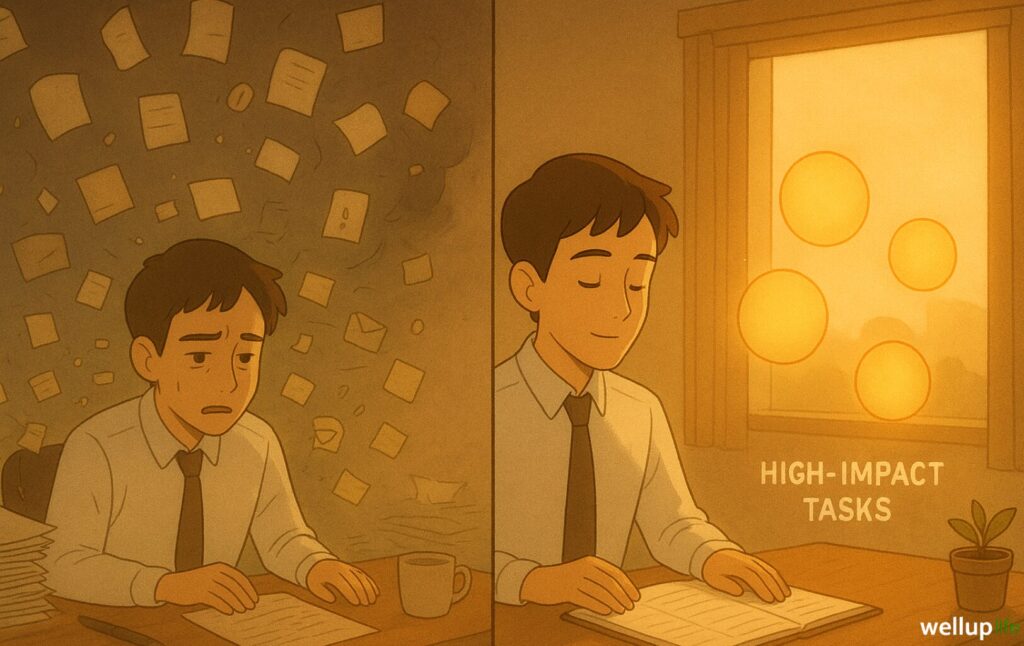
One of the biggest reasons we procrastinate is that the task in front of us feels too big. Not big in terms of time — big in terms of emotion.
When something looks huge, unclear, or demanding, your brain labels it as a “threat,” and naturally tries to avoid it. That’s why even simple work can feel impossible to start when the first step isn’t obvious. Research shows that perceived task difficulty increases avoidance and emotional resistance. [5]Research showing that perceived task difficulty increases avoidance and emotional resistance..
Breaking a task down into small, doable pieces takes away that emotional weight.
Suddenly, the task stops being “Write the whole chapter” and becomes “Open the document” → “Write one sentence.” That feels safer, lighter, and much more doable.
When your brain sees a smaller step, it no longer triggers the same avoidance response. In fact, taking even a tiny action gives you a small dopamine release — your mind’s way of rewarding progress — which makes the next step easier. Studies show that completing small tasks activates reward pathways and builds motivation. [6]Why Celebrating Small Wins Boosts Motivation..
You don’t need to finish the whole thing.
You just need to begin with something so small that your mind doesn’t feel threatened by it.
Try this:
Take the task you’ve been avoiding and ask, “What is the smallest, easiest version of this I can start with?”
That’s your starting point — your 1% action.
Once you begin, momentum naturally follows. Not because you suddenly became more productive, but because the mountain turned into a gentle step.
And that’s enough to move forward.
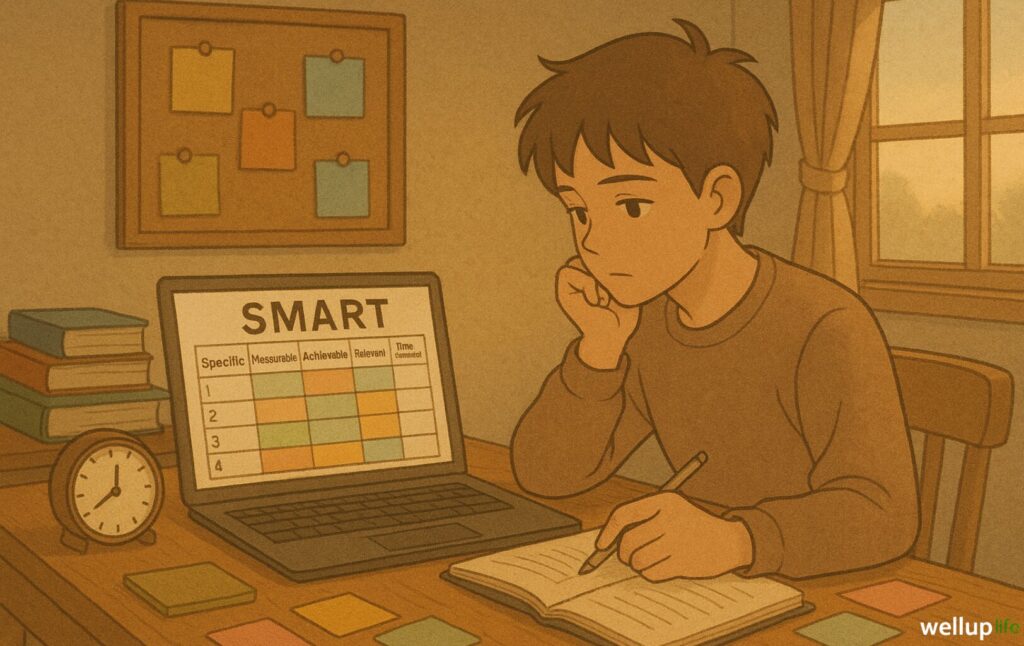
A lot of procrastination comes from one simple thing: uncertainty.
When you don’t know exactly what you’re supposed to do or when you’re supposed to do it, your mind naturally drifts toward whatever feels easier. The brain hates ambiguity. It prefers clear instructions and defined boundaries. Studies show that vague goals increase avoidance and reduce task initiation. [7]The Neuroscience of Goals and Behavior Change.
That’s why a clear, time-bound plan makes such a big difference.
When you decide what you’ll do and when you’ll do it, the task stops feeling like a cloud hanging over your head and becomes something concrete — something with shape and direction.
You don’t need an hour-by-hour schedule.
Just give your day a bit of structure—a gentle container.
Try this simple method:
Pick your 3 most important tasks for the day.
Not 10. Not 7. Just 3.
It keeps your mind focused and reduces decision fatigue — a major trigger for procrastination. Decision fatigue research shows how too many choices reduce self-control and task completion. [8]Too Many Choices — Good or Bad — Can Be Mentally Exhausting.
Once you’ve picked your 3 tasks, assign a time window to each.
Not a strict deadline — just a timeframe like:
Even if you don’t follow it perfectly, the act of planning gives your mind a direction. It removes the stress of constantly deciding, “What should I do next?”
Clarity reduces overwhelm.
And when overwhelm drops, procrastination naturally drops with it.
Create a simple plan. Give your tasks a home.
Your mind will rest easier — and starting will feel much simpler.
Even if you’re motivated… even if you’re clear about what to do… a small distraction is enough to pull you completely off track.
Not because you’re mentally weak, but because the human brain is wired to respond to stimulation — especially the quick, easy kind that apps are designed to give you. Research shows that digital notifications trigger immediate attentional shifts due to their reward design. [9]Investigating the Effects of a Notification-Disabling Intervention on Smartphone Behavior and Digital Well-Being.
If your environment is constantly nudging you toward something more exciting, your mind will choose that over the difficult task — almost automatically.
That’s why creating a small focus zone matters so much.
It doesn’t have to be a perfect workspace with candles and plants (unless you like that). You just need a setup that tells your brain, “This is where we focus. Nothing else matters right now.”
A few things help:
You’re not trying to build perfect discipline.
You’re just giving your mind fewer temptations so it can do what it’s naturally capable of: focus deeply for short, meaningful periods.
A good environment doesn’t replace motivation — but it makes motivation unnecessary for getting started.
Sometimes the hardest part isn’t doing the task — it’s starting it.
Your mind builds this huge story about how difficult, exhausting, or time-consuming the task will be. And that story becomes so heavy that the first step feels impossible.
That’s where the 2-Minute Rule helps.
The idea is simple:
If a task feels overwhelming, shrink it down to something you can do in two minutes or less.
Not because the entire task will be done in two minutes, but because starting creates momentum. Once you begin, your brain shifts from avoidance mode to action mode.
This works because taking a small action triggers a quick sense of progress, which boosts dopamine — the neurotransmitter that fuels motivation and forward movement. Research shows that progress, even little progress, activates the brain’s reward pathways and increases motivation. [11]Seeking motivation and reward: Roles of dopamine, hippocampus, and supramammillo-septal pathway
Think of it like gently opening a stuck door — you don’t break it open; you nudge it until it moves.
A few examples:
The magic is in the start. Once you begin, even slightly, you often end up doing much more than two minutes — not because you forced yourself, but because the resistance softened.
Action reduces anxiety.
And tiny action makes big action possible.
Give yourself permission to start small.
Two minutes is enough to change the direction of your entire day.
Procrastination gets stronger when no one knows what you’re supposed to be doing — and weaker when you feel supported, seen, or guided. That’s why accountability works so well. It adds a gentle sense of commitment, not pressure.
When you tell someone,
“Hey, I’m working on this today,”
Your mind naturally becomes more focused. You’re not doing it alone anymore, and that small social connection makes it easier to follow through.
Research shows that sharing your goals with someone you respect increases your chances of completing them [12]Psychological Secrets to Hack Your Way to Better Life Habits
This doesn’t mean you need an “accountability buddy” or a group chat (unless you like that). Even a simple message to a friend or a quick note on a shared tracker can create enough of a nudge to keep you consistent.
The second part of this step is just as important:
reward your progress — even the small wins.
Your brain thrives on positive reinforcement. When you celebrate tiny steps, you strengthen the habit loop, making it easier to repeat the behavior.
A reward doesn’t need to be big. It can be:
These small celebrations teach your brain: Starting feels good. Finishing feels even better.
Accountability gets you moving.
Rewards keep you moving.
Together, they turn effort into a habit — and consistency into something you actually look forward to.
Sometimes it’s not one big thing that helps you stop procrastinating — it’s a few gentle shifts that make your day feel lighter and more manageable. Here are some extra tips you can keep in your pocket:
When your mind feels scattered, even small tasks feel heavy. In this case, mindfulness practices such as a minute of slow breathing or grounding techniques can calm your nervous system and make starting easier [13]Effects of Mindfulness on Psychological Health: A Review of Empirical Studies.
Just pause, breathe, and notice what you’re feeling.
Sometimes that alone breaks the cycle.
You don’t have to finish the entire task right now.
You just have to move it forward a little.
“All or nothing” thinking is one of the biggest triggers of procrastination — because if you can’t do it perfectly, your mind feels safer avoiding it.
When you allow yourself to make imperfect progress, the pressure fades.
Progress > Perfection. Always.
A warm cup of tea.
A clean desk.
Opening your notebook.
Playing a certain playlist.
These small rituals act as cues that signal your brain to switch into focus mode. They reduce friction and make starting feel natural.
Procrastination increases when your body is low on energy, sleep, or nutrition. The brain’s ability to regulate focus and self-control is directly affected by your physical state. Studies show that sleep deprivation impairs cognitive control and increases impulsivity. [14]Studies show that sleep deprivation impairs cognitive control and increases impulsivity.. Research also finds that the person who is physically active has improved focus, mood, and executive functioning.
[15]Impact of physical activity on executive functions: a moderated mediation model.
Sometimes you don’t need more motivation — you just need rest, water, or a short walk.
Decision fatigue is real. The more choices you make throughout the day, the harder it becomes to start important tasks. Decision fatigue research shows that repeated choices drain self-control. [16]Decisions, Decisions: The Brain Drain of Decision Fatigue
Make your mornings simple:
Pick your clothes the night before.
Plan your top 3 tasks early.
Automate what you can.
Fewer decisions → more energy for what matters.
Procrastination isn’t something you “fix” overnight. It’s something you gently unlearn — one small step, one tiny action, one compassionate moment at a time.
You don’t need to be perfectly disciplined.
You don’t need to feel motivated every morning.
You just need to show up for yourself in small, honest ways.
Some days you’ll move faster.
Some days you’ll only manage a few minutes.
Both count. Both are progress.
The real shift happens when you stop treating procrastination as a personal failing and start seeing it as a signal — a gentle whisper from your mind saying, “I feel overwhelmed. Make this easier for me.”
And now, you have the tools to do exactly that.
Take a breath. Take a step.
Today is enough.
You don’t have to change everything at once.
Just one gentle shift today is enough to move you forward.
Read Next: The Pareto Principle (80/20 Rule): How to Focus on What Truly Matters