Physical Address
304 North Cardinal St.
Dorchester Center, MA 02124

Physical Address
304 North Cardinal St.
Dorchester Center, MA 02124
Written By:
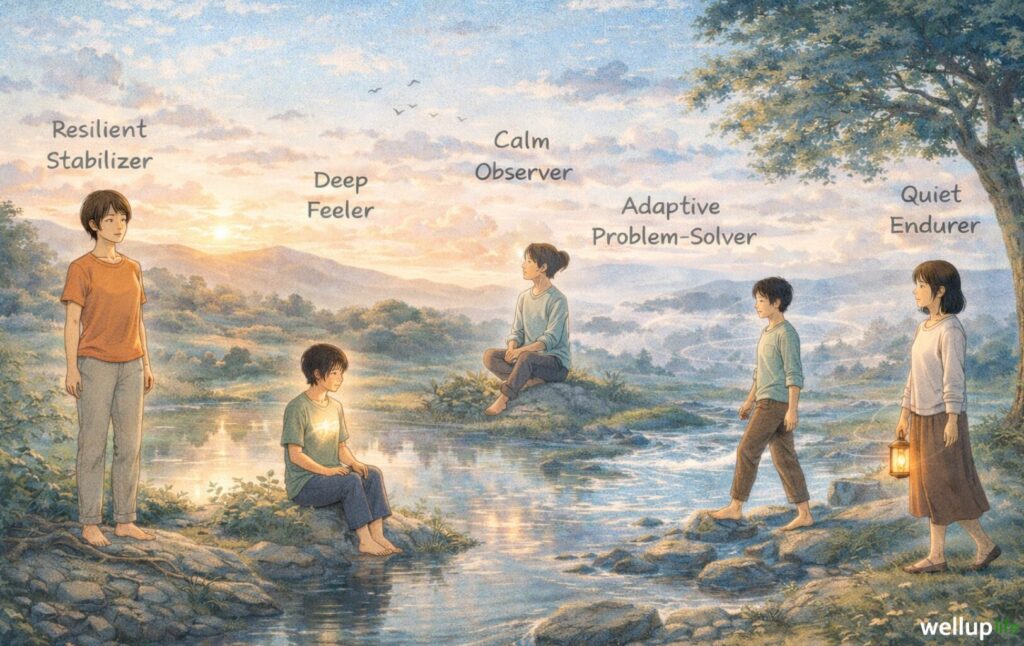
Not everyone handles emotions the same way.
Some people stay steady when life gets chaotic.
Some feel everything deeply.
Some adapt quickly.
Some endure quietly without showing much on the outside.
All of these are forms of emotional strength — and none of them are wrong.
This quiz isn’t about labeling you as “strong” or “weak.”
It’s about understanding how you naturally respond, cope, and recover when emotions run high.
Your emotional strength type shapes how you deal with stress, relationships, failure, and uncertainty — often without you even realizing it.
Take this short quiz to discover your emotional strength type, recognize your hidden strengths, and understand what kind of emotional support actually works best for you.
This isn’t a test. It’s simply a moment of honest self-reflection.
Emotional strength isn’t about being tough, calm, or unbothered all the time.
It’s about how you naturally cope, regulate, and move through emotional experiences.
Here are the five emotional strength types explained in more depth — not as labels, but as natural patterns.
Resilient Stabilizers are the emotional anchors in difficult situations.
When stress rises, your instinct is to ground yourself first. You don’t spiral easily. You focus on staying steady — internally and externally. Even when emotions are present, you know how to regulate them enough to keep functioning.
People often feel safe around you because your calmness doesn’t feel forced. It feels stable.
How this shows up in life:
Where it can get difficult:
You may prioritize stability so much that you minimize or delay emotional expression. Over time, this can lead to emotional buildup if you never slow down enough to feel.
Deep Feelers experience emotions with intensity and honesty.
You don’t brush feelings aside — you experience them. This gives you empathy, emotional intelligence, and the ability to form deep emotional bonds. You often sense emotional shifts before others do.
Your emotional strength lies in depth, sensitivity, and emotional truth.
How this shows up in life:
Where it can get difficult:
Because emotions are vivid, they can sometimes feel overwhelming. Without boundaries, you may absorb others’ emotions or identify too strongly with temporary feelings.
Calm Observers relate to emotions through awareness rather than reaction.
When emotions arise, you naturally step back and observe what’s happening inside you. You think before reacting. You notice patterns in your thoughts and feelings. This gives you clarity and perspective in emotionally charged moments.
Your strength lies in mindfulness and emotional insight.
How this shows up in life:
Where it can get difficult:
Sometimes observation turns into emotional distance. You may understand emotions well but struggle to fully engage or express them openly.
Adaptive Problem-Solvers handle emotions by doing something about them.
When discomfort arises, your instinct is action. You focus on solutions, plans, and next steps. This makes you highly adaptable and effective during stressful situations.
Your emotional strength lies in forward movement and practicality.
How this shows up in life:
Where it can get difficult:
You may unintentionally avoid emotions by staying busy or solution-focused. Some feelings don’t need fixing — they need acknowledgement.
Quiet Endurers carry emotional weight silently.
You don’t express much, but you endure a lot. You keep going even when things are hard. Your emotional strength is subtle but powerful — rooted in persistence, loyalty, and inner toughness.
Often, others don’t realize how much you’re handling.
How this shows up in life:
Where it can get difficult:
By holding everything in, you may neglect your own emotional needs. Suppressed emotions don’t disappear — they wait.
No emotional strength type is better than another.
Each one represents a different way the human mind protects itself.
Growth doesn’t mean changing who you are.
It means using your emotional strength consciously — not automatically.
Understanding your emotional strength type isn’t about putting yourself into a box.
It’s about recognizing the pattern you already live in.
Most emotional stress doesn’t come from feelings themselves — it comes from not understanding how we handle them. When you know your emotional strength type, you stop fighting your natural responses and start working with them.
Here’s why that awareness matters:
Many people think they’re “too emotional,” “too detached,” or “too silent.”
Your emotional strength type shows that these aren’t flaws — they’re coping styles. Self-judgment softens when understanding replaces comparison.
When you recognize your default emotional pattern, you catch yourself sooner.
That pause — even a small one — creates space for better responses instead of automatic reactions.
Not everyone needs the same advice or coping tools.
Some people need grounding. Some need expression. Some need space. Knowing your type helps you seek the right kind of support, not generic solutions.
Emotional misunderstandings often come from different coping styles.
Understanding your type helps you communicate your needs more clearly — and understand others with less frustration.
Personal growth isn’t about becoming someone else.
It’s about refining your natural strengths and gently balancing your blind spots.
You don’t need to change your emotional nature to grow.
You just need to understand it.
Knowing your emotional strength type is useful only if it helps you live better in small, ordinary moments.
Here’s how each emotional strength can be used consciously in everyday life.
Daily reminder: Stability grows stronger when emotions are allowed, not ignored.
Daily reminder: Feeling deeply is powerful — pacing yourself protects that power.
Daily reminder: Awareness becomes wisdom when it’s shared.
Daily reminder: Not everything needs solving to be healed.
Daily reminder: Endurance doesn’t mean carrying everything alone.
Your emotional strength already works for you.
Growth begins when you start noticing how you use it each day.
Not completely — and that’s not a problem.
Your emotional strength type is shaped by your temperament, early experiences, and how you learned to cope with emotions. Because of that, your core tendency usually stays the same.
What does change is how you use it — especially depending on whether you feel safe or stressed.
When life feels overwhelming or unsafe, people often lean harder into their default coping style:
These shifts aren’t failures.
They’re the nervous system trying to protect you.
When you feel supported, understood, or emotionally safe, your strength becomes more balanced:
Safety doesn’t change who you are — it will enable more of you to show up.
Growth isn’t about becoming a different emotional type.
It’s about recognizing when stress is narrowing your responses — and gently guiding yourself back to balance.
As awareness grows, you don’t abandon your emotional strength.
You use it with more choice and less pressure.
Your emotional strength doesn’t disappear under stress.
It just tightens. Safety helps it breathe again.
Emotional strength isn’t about being unshaken or always in control.
It’s about knowing how you naturally move through emotions — and treating that pattern with understanding instead of judgment.
This quiz isn’t meant to define you.
It’s meant to help you notice yourself more clearly.
When you understand your emotional strength type, you stop forcing yourself into strategies that don’t fit. You begin choosing responses, support, and habits that align with who you already are.
That’s where real emotional well-being begins — not in changing yourself, but in meeting yourself with awareness and care.