Physical Address
304 North Cardinal St.
Dorchester Center, MA 02124

Physical Address
304 North Cardinal St.
Dorchester Center, MA 02124
Written By:
Reviewed By:
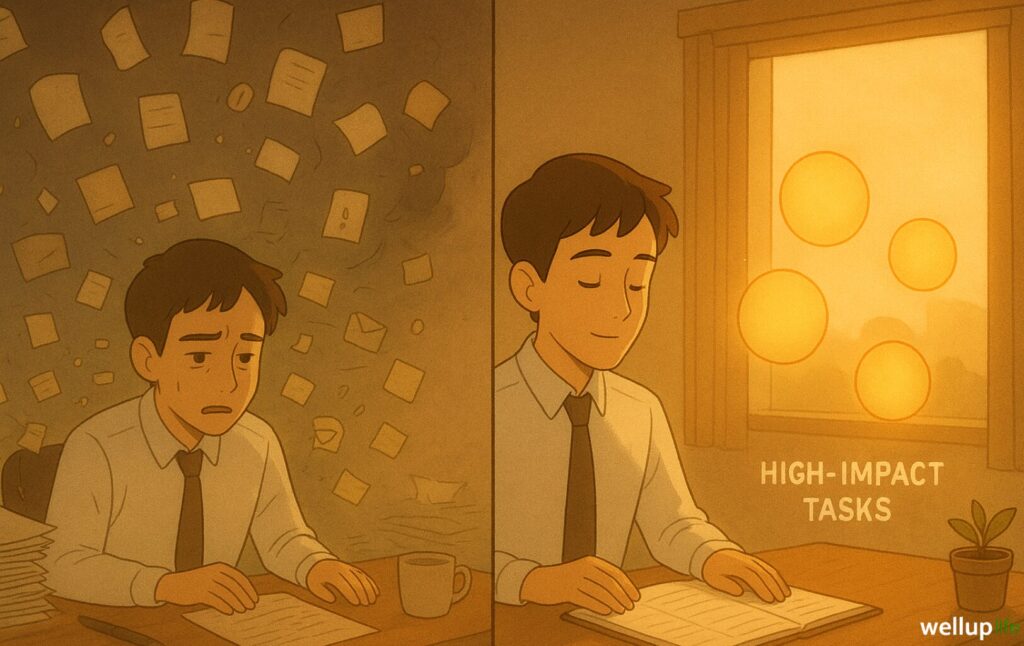
Ever had one of those days where you’re running from task to task, replying to messages, checking things off, staying “busy”… but when the day ends, you quietly wonder, “Why doesn’t it feel like I actually moved forward?”
If you have ever had days like that, then you’re not alone. Most of us spend our days in motion, not in progress. And it’s not because we’re lazy or undisciplined — it’s because our minds naturally drift toward whatever feels urgent, easy, or familiar. We stay active, but not aligned.
This is where the 80/20 principle quietly enters the room.
The 80/20 principle says that a small portion of what we do — the meaningful 20% — creates most of the value in our lives. The rest? They’re the things that keep us busy, but not necessarily fulfilled.
And the tricky part is… the 80% often looks productive. It gives quick wins, temporary relief, or the illusion of being in control. But deep inside, you know the difference between something that moves your life forward… and something that just fills the space.
In this article, let’s gently explore why this happens, how to recognize your own 80/20 trap, and how small shifts in your day can bring clarity, calm, and genuine progress — without hustling harder.
So, what is the 80/20 rule? At first instance, the 80/20 rule sounds complicated, but at its heart, it’s beautifully simple:
The 80/20 rule says that a small portion of what you do creates most of your meaningful results.
This idea comes from economist Vilfredo Pareto, who observed over a century ago that 80% of Italy’s land was owned by 20% of the people. Later, researchers noticed this pattern showing up everywhere — in business, habits, productivity, and even nature. It isn’t a strict formula, but a pattern of imbalance that appears again and again.
And here’s the part that matters for your life:
Not everything you do carries the same weight.
Some meaningful actions — your 20% — move you forward, bring clarity, reduce stress, or create real progress. Others — the remaining 80% — keep you busy, distracted, and often drained.
What most people don’t realize is that the 80/20 rule is not about cutting your life down or being hyper-efficient. It’s about alignment.
It’s about noticing:
And because our brains naturally gravitate toward the quick, the familiar, and the easy (a tendency supported by cognitive psychology research on “cognitive ease”), we often drift into the 80% without even noticing. We check the inbox, reply to notifications, jump between tiny tasks — and suddenly the day is gone.
So the 80/20 principle isn’t a rule to obey… It’s a mirror.
It helps you see where your time is going — and whether it’s going where your life needs it to.
Most people don’t even notice when they slip into the 80% zone — it feels normal, even productive. But there are quiet signs your day is drifting away from the things that actually matter.
Here are some signs that tell you’re stuck in the 80/20 trap.
If your day is full, your hands are always moving, but when you look back, nothing meaningful has shifted, then maybe you are unknowingly focusing on the 80% non-meaningful tasks.
This is the very basic sign that you are trapped in your 80%. You feel mentally scattered because you have no clarity over what you are doing. Your mind is just moving here and there. Replying to messages, switching tabs, checking updates — they seem harmless, but they drain your energy in tiny drops, and over time, those drops become a flood. You become mentally exhausted.
Anything that makes you mentally exhausted and drained is a strong sign that you have slipped into the pool of non-meaningful tasks.
Reacting means what, exactly?
It means you’re not directing your day with awareness — you’re being carried by emotions, impulses, and whatever shows up externally. Instead of choosing, you’re being pulled.
Notifications pull you.
Messages pull you.
Urgent things pull you.
Even small temptations grab your attention.
But very few actions come from your intention or clarity.
It’s like the day is driving you…
And you’re just sitting in the passenger seat.
If this sounds familiar, then maybe you’re trapped in your 80%.
This is the classic 80% trap.
Feeling that something is urgent and something actually being important are two completely different things.
Your brain loves small tasks because it believes, “This will only take a minute… let me just finish it and get it out of the way.” So it creates an illusion of urgency, even when the task is unimportant or has almost no impact on your growth.
The brain instinctively wants to close loops and finish quick tasks because they give instant relief. Psychologists call this the completion bias — we feel good checking things off, even if those things don’t truly matter.
On the other hand, important tasks feel overwhelming.
They require energy, clarity, and deeper thinking.
So the brain tries to avoid them and waits for a “perfect time” to start — a time that never really comes.
If you’ve developed a habit of doing things that feel urgent but aren’t actually important, you might be stuck in your 80% zone without even realizing it.
You do it, not because you’re lazy — but because the meaningful work feels heavy. We have discussed this in the above section. Important tasks usually require clarity, courage, or emotional energy. So the mind will quietly slip toward anything that feels more comfortable.
If your brain is constantly slipping in that way to do the easy work first, there is a high chance that you are avoiding your meaningful task that contributes to your real progress. And it is a clear sign that you are trapped in your 80%.
That subtle ache of “I was active, but not effective” is one of the clearest signs that you spent your day in the 80% zone.
Why is it such a clear signal?
Think about it: when you end your day tired, it’s often because you were juggling dozens of small, unimportant tasks.
Your mind kept jumping from one thing to another, burning energy without building momentum. That constant switching exhausts you, drains your focus, and leaves you mentally scattered.
And then there’s the second feeling — the lack of satisfaction.
Why does that happen?
Because even though you were busy, you weren’t doing the work that aligns with your goals, values, or direction. You weren’t touching the tasks that actually move your life forward.
Activity happened… but progress didn’t.
These signs aren’t there to judge you.
They’re gentle indicators — little reminders from your mind and body.
If you’re feeling them, it simply means you’re human… and probably stretched thin.
But noticing them is powerful.
Awareness is the first step toward stepping out of the 80% zone and returning to the meaningful 20%, where your effort actually creates change.
If you’ve ever had a day where you kept moving but didn’t meaningfully move forward, yes, then you’ve experienced the 80% zone.
Falling into your 80% zone isn’t a sign of weakness. It’s a sign that your brain is doing exactly what it’s designed to do — protect you from effort, discomfort, uncertainty, and emotional weight.
Let’s understand why this happens, layer by layer.
Daniel Kahneman — one of the world’s most respected psychologists — explains that the mind always tries to choose the path of least resistance [1]Cognitive Ease & Coherent Stories.
He calls this cognitive ease, meaning:
So, responding to messages? Feels easy.
Refreshing notifications? Feels normal.
Revising your website layout? Feels manageable.
Starting your big exam prep, writing a chapter, or planning a business idea? Feels heavy, uncertain, emotionally loaded.
This is why your brain quietly pushes you toward the low-value 80%.
It’s not your fault — it’s just your brain choosing the safest emotional option.
Important work almost always triggers some form of fear or discomfort:
And emotional weight is the one thing the brain really doesn’t like.
The research published in the Sage Journals reports that when a task triggers emotional discomfort, the mind instinctively looks for escape routes — usually by doing smaller, low-stakes tasks that give the illusion of productivity [2]Task Avoidance and Emotional Regulation – APA.
So when you avoid studying, writing, building, or planning — it’s not procrastination.
It’s self-protection.
The brain says:
“Let’s do something easier… something that doesn’t make me feel vulnerable.”
When you have too many tabs open (literally and mentally), it becomes harder to think clearly.
This isn’t a personality issue — it’s biology.
Research published by NCBI (National Center for Biotechnology Information) shows that cognitive overload reduces the functioning of the prefrontal cortex — the brain region responsible for clarity, prioritization, planning, and long-term thinking [3]Cognitive Overload Impairs Executive Function – NCBI.
When clarity drops, everything begins to feel urgent, and important tasks start to look threatening.
You default to the comfortable 80% because it requires less internal organization.
Overwhelm doesn’t create laziness. It creates blindness.
Every time you complete a tiny task — reply, check, refresh, click — your brain gets a small hit of dopamine, the reward chemical.
A review in Brain Research Reviews explains that our brain becomes addicted to “micro-rewards,” even if the actions themselves don’t matter in the long run [4]Reward mechanisms in the brain and their role in dependence: evidence from neurophysiological and neuroimaging studies.
This creates a loop:
tiny task → small dopamine → feels productive → repeat
So the brain constantly seeks the next “easy win”…
even if the bigger, more meaningful task sits untouched.
This is why you can stay busy for hours and still feel empty at the end.
We live in a world that celebrates being busy.
People admire workloads, late nights, endless tasks, and full calendars.
You rarely hear someone say, “I’m proud that I rested, reflected, and worked intentionally today.”
But stillness is often where the real breakthroughs happen.
A famous study by the University of California, Irvine, shows that frequent interruptions and task-switching (the hallmark of busyness) not only kill productivity but also significantly increase stress and mental fatigue [5]The Cost of Interrupted Work – UC Irvine.
So while the world rewards activity… your brain and your life benefit from clarity.
Busyness feels productive. But progress feels quiet.
Most people stay in the 80% because they never take time to pause and ask what actually matters. And it makes sense — silence is uncomfortable. Reflection slows you down. Being honest with yourself requires courage.
So instead, you keep moving. You fill every gap. You say yes to everything. You avoid the stillness that would force you to face your real priorities.
The truth is simple:
People don’t lack productivity — they lack quiet clarity.
Without reflection, everything feels equally important, and when everything feels important… You naturally choose the easiest thing.
None of this means you’re undisciplined or “not focused.” It means you’re human.
Your brain is trying to:
But once you’re aware of these patterns, you stop operating on autopilot. Awareness breaks the spell. And from that point on, shifting into your 20% feels natural… not forced.
If the 80% zone is the place where your energy leaks, then your 20% is where your life expands.
These are the few actions, habits, and decisions that actually move you forward — in work, relationships, studies, health, and personal peace.
But here’s the challenge: Most people never clearly identify their 20%. They feel it… But they don’t define it.
Here are some ways that can help you identify your 20%.
Your 20% always gives you more clarity than you had before doing it.
Some tasks leave your mind calmer, your direction clearer, your next step obvious.
These are signs you’re touching a high-impact action.
Examples:
Clarity is a quiet but reliable indicator of the 20%.
Productivity research increasingly shows that energy is a better indicator than time.
A study published in the Journal of Organizational Behavior notes that tasks aligned with internal motivation create more sustainable energy and focus [6]Work Engagement and Internal Motivation – Journal of Organizational Behavior.
Your 20% often feels like:
Your body often knows before your mind does.
The 80% gives temporary satisfaction.
The 20% creates long-term value.
A simple question to ask yourself:
“Will this matter 6 months from now?”
Your 20% is always connected to long-term outcomes.
Your 20% often reduces 10 future problems.
For example:
Research on “preemptive coping” shows that proactive actions significantly reduce future stress [7]Solving Tomorrow’s Problems Today? Daily Anticipatory Coping and Reactivity to Daily Stressors.
Your 20% makes future life lighter.
Here’s the uncomfortable truth:
The task you resist the most is usually the one that matters the most. Not because it’s difficult — but because it leads to growth.
The brain avoids emotionally meaningful tasks because they stretch your identity.
But that stretch is exactly where the 20% lives.
A study on resistance and emotional significance published in Springer Nature Link found that the tasks we avoid usually carry personal importance [8]The Role of Approach and Avoidance Motivation and Emotion Regulation in Coping Via Health Information Seeking.
So when you feel resistance, don’t run from it — get curious.
Here’s a simple sentence that cuts through noise:
“If I could only complete one thing today, what would genuinely move my life forward?”
This single question forces:
Your 20% reveals itself immediately when you limit yourself to one meaningful thing.
This is the most important point:
Your 20% is always connected to the person you want to become.
Your identity shapes your priorities. When you know who you want to become, the 20% becomes obvious.
Your meaningful 20% is not about doing more — it’s about doing what matters.
It’s rarely loud.
It’s rarely urgent.
It’s rarely comfortable.
But it’s the only work that creates real movement in your life. And once you learn to recognize it, your days stop feeling chaotic — and start feeling intentional.
Identifying your 20% is the first step. Living it — day after day — is where the real transformation happens.
But here’s something important to remember: You don’t need to shift your life by forcing yourself into massive changes. You shift it by realigning small choices, every day, toward what actually matters.
Here are the ways that can help you shift your day towards the 20%.
Just one protected hour a day — for deep, high-value work — can create a completely different life over time.
Studies from Cal Newport’s Deep Work research show that a focused hour produces exponentially more meaningful results than three hours of distracted effort [9]Deep Work: Rules for Focused Success in a Distracted World – Cal Newport.
You don’t need more hours. You need one hour of protected clarity.
Keep your phone away.
Notifications are off.
Only one meaningful task is in front of you.
That’s your daily 20% anchor.
If the first thing you do is check your phone, you immediately enter the 80% zone — reacting, not choosing.
Research published in the National Center for Biotechnology Information found that people who begin their day with intentional planning experience less stress and higher task completion [10]When daily planning improves employee performance.
Before touching your phone, ask yourself:
“What are the 1–2 things that would genuinely make today meaningful?”
The day feels different when you choose your direction instead of letting the world choose it for you.
This simple method changes lives.
Every morning, decide:
“If nothing else gets done today, this one thing will still move my life forward.”
It could be:
The brain can handle one meaningful challenge far more easily than a list of ten. This builds momentum without pressure.
You don’t need to eliminate all distractions — just the biggest ones.
Common energy leaks:
A study by Stanford University shows that chronic multitasking reduces focus, memory, and overall mental clarity [11]Cognitive Costs of Multitasking – Stanford University.
When you reduce energy leaks, the 20% becomes naturally easier.
Decisions drain willpower. But routines save it.
If you decide every day whether to study, write, work out, or plan, you burn mental energy.
But if it becomes a routine (like brushing your teeth), your brain stops resisting it.
Habit research from BJ Fogg’s Behavior Model shows that small, consistent actions create long-term change more reliably than big motivational pushes [12]Tiny Habits and Behavior Design – BJ Fogg.
Your 20% becomes powerful when it becomes routine.
Instead of asking, “When should I do this?”
Ask, “When do I feel most mentally fresh?”
For many people:
You don’t have to follow a one-size-fits-all schedule. You have to understand your personal rhythm.
An article on chronotypes (your natural energy cycles) published in Robert Walters shows that aligning tasks with your energy greatly increases performance [13]Chronoworking: How to align your workday with your natural energy levels.
Find your peak energy window — and put your 20% there.
A simple end-of-day reflection helps your brain reset instead of carrying unfinished loops into tomorrow.
Ask yourself:
A study in the National Center for Biotechnology Information found that writing down next-day tasks reduces mental load and improves sleep quality [14]The Effects of Bedtime Writing on Difficulty Falling Asleep – PubMed Central.
Reflection takes 5 minutes — but it clears hours of mental clutter.
You don’t need a perfect system.
You don’t need to hustle harder.
You don’t even need motivation every day.
You only need:
Your life doesn’t change by doing more.
It changes by doing what matters… just a little more often.
Sometimes concepts feel clear, but the real shift happens when you see how it looks in everyday life.
So here’s an example — a day stuck in the 80%… and the same day shifted gently toward the 20%.
Let’s imagine someone like all of us: someone juggling studies, work, messages, goals, and an endless to-do list.
8:00 AM — Wakes up and checks the phone
Messages, notifications, reels.
The mind starts in reaction mode.
Feels a bit scattered already.
9:00 AM — Tries to start studying
But switches tabs.
Watch one video.
Replies to a few messages.
Studies for 10 minutes, gets distracted again.
10:00 AM — Handles small tasks
Organizes files.
Checks email.
Updates something that wasn’t urgent.
Feels “busy” but not satisfied.
12:00 PM — Lunch with mind still in 10 open loops
Thinking about tasks he hasn’t done.
Watching reels while eating.
Mind feels noisy.
2:00 PM — More low-value tasks
Goes through social media.
Watch something “for a break” that turns into hours.
Starts another task, doesn’t finish it.
5:00 PM — Feels tired and disappointed
Thinks, “Where did the day even go?”
Feels guilty, stressed, and low on energy.
10:00 PM — Sleeps with mental tabs open
Starts the next day, already behind.
This isn’t laziness.
It’s the 80% zone silently taking over.
8:00 AM — Wakes up, takes 2 minutes to breathe
No phone yet.
Just a quiet moment.
Asks the question:
“What one thing would make today meaningful?”
He chooses:
One focused hour of study — his 20%.
8:30 AM — Starts his 20% hour
Phone outside the room.
One chapter.
Deep focus.
No rush.
Finishes at 9:30 AM feeling:
10:00 AM — Handles a few small tasks intentionally
But they no longer run the day.
They’re just background.
12:00 PM — Lunch with a calm mind
Knows the most meaningful thing is already done.
2:00 PM — Does another small 20% action
Maybe write for 20 minutes.
Or planning tomorrow.
Nothing dramatic — but aligned.
5:00 PM — Ends the day feeling satisfied
Not because he did “everything”…
But because he did the right things.
10:00 PM — Sleeps with a quiet mind
Because the day didn’t slip through his fingers.
Both days had the same number of hours.
Both days involved distractions, small tasks, and responsibilities.
The difference was simple:
The 20% doesn’t require a perfect system.
It requires one protected, meaningful hour of clarity each day.
A day built around your 20% feels calmer, lighter, and more intentional — even if nothing else changes.
The 80/20 rule (also called the Pareto Principle) says that a small portion of your actions — around 20% — creates most of your meaningful results.
It’s not a strict ratio, but a pattern showing up in studies, economies, habits, and human behavior.
It’s basically saying:
“A few things matter a lot. Most things matter only a little.”
The concept originated from economist Vilfredo Pareto, who observed that 80% of Italy’s land was owned by 20% of people. Over time, psychologists, economists, and productivity researchers noticed similar imbalances in different fields.
While it’s not a mathematical law, there’s strong research supporting the idea of unequal contribution, such as how small habits produce the most long-term results, or how a few tasks account for most progress.
You’re likely in the 80% if:
You’re busy all day but not moving forward
Your energy feels scattered
You do easy tasks first
You avoid meaningful work because it feels heavy
You end the day tired but unsatisfied
Your body often knows before your mind — heavy, scattered energy usually means 80%.
Absolutely.
In studies, your 20% might be:
The key concepts that drive understanding
The 2–3 chapters that appear most in exams
The high-quality practice that improves accuracy
Revision over random note-taking
Many students spend hours in the 80% zone — reading, highlighting, re-reading — but real marks come from the meaningful 20%: understanding + practice.
Yes.
In relationships, a few behaviors (your 20%) create most of the connection:
active listening
presence
honest communication
small acts of care
And most conflicts (the 80%) come from small, repetitive misunderstandings.
Focusing on the meaningful 20% strengthens any bond.
No.
The 80/20 rule isn’t about neglect — it’s about priority.
You still handle small tasks, but you don’t let them control your day.
You do the meaningful 20% first and let the 80% fill the remaining time naturally. This one shift changes everything.
Yes — actually, working longer hours often makes productivity worse.
Research on deep work and focus shows that short, intentional bursts of meaningful work outperform long days of shallow busyness. Your life changes not when you do more… but when you do what actually matters.
Start with these simple questions:
What brings me clarity?
What reduces future stress?
What moves my life forward?
Which tasks do I avoid but know I need?
What aligns with who I want to become?
Your 20% is always connected to growth, clarity, and long-term benefit.
Yes — your 20% depends on your goals, values, season of life, and identity.
Someone preparing for exams will have a different 20% than someone building a business or someone healing emotionally.
But the pattern is universal: A few things matter much more than the rest.
Make it:
small
simple
routine
protected
You don’t need perfection.
You just need to touch your meaningful 20% every single day — even for 30 minutes.
That’s how alignment grows.
At the end of the day, you don’t need more hours, more motivation, or more hustle. You need to give your energy to the things that truly matter.
The 80/20 rule isn’t a business trick or a clever productivity hack — it’s a reminder of something deeply human:
A small portion of your actions shapes most of your life. And when you choose those actions intentionally, everything feels lighter, clearer, calmer.
You begin to move from:
You stop chasing the illusion of doing everything, and finally focus on the few things that genuinely move you forward.
And the beautiful part? You don’t need to do it perfectly. Even a small step toward your 20% each day changes the texture of your whole life.
One meaningful hour.
One aligned task.
One clear decision.
That’s enough to shift everything.
Your life doesn’t change when you do more.
It changes when you do what matters — and do it with intention.
Read Next: The Pareto Principle (80/20 Rule): How to Focus on What Truly Matters