Physical Address
304 North Cardinal St.
Dorchester Center, MA 02124

Physical Address
304 North Cardinal St.
Dorchester Center, MA 02124
Written By:
Reviewed By:
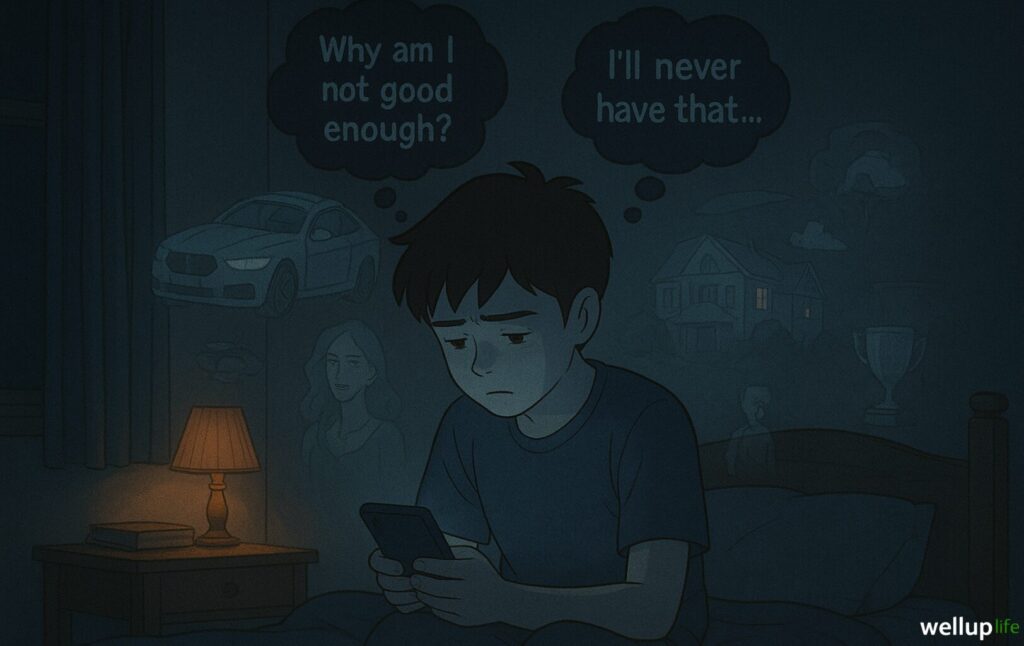
Ever found yourself scrolling through Instagram, seeing a friend’s vacation photos or a colleague’s promotion, and suddenly feeling like you’re falling behind? That sinking feeling isn’t just in your head—it’s a common experience. Social media amplifies our tendency to compare, often leading to feelings of inadequacy and decreased self-esteem SourcePsychologist Tim Bono on social media and comparison .
But here’s the truth: you’re not alone in this. Constant social comparison, especially online, can contribute to anxiety, depression, and low self-esteem SourceJed Foundation report on social comparison and mental health .
The good news? Recognizing your comparison triggers and learning how to focus on your own journey can significantly improve your well-being SourcePsychology Today on avoiding comparison traps .
In this article, we’ll explore why we fall into the comparison trap, the hidden costs it imposes on our well-being, and practical, relatable steps to stop comparing yourself to others. Let’s embark on this journey together and rediscover the peace that comes from embracing your unique path.
Have you ever noticed that the more you compare yourself to others, the worse you feel? That’s because comparison is hardwired into human psychology. Humans naturally assess themselves relative to others—it’s called social comparison SourceLeon Festinger's Social Comparison Theory, 1954 . From a young age, we’re taught to measure our achievements, appearance, and success against those around us, which makes the comparison trap almost unavoidable.
There are two main types of comparison that can sneak into our daily lives:
In today’s social media-driven world, these comparisons happen almost constantly. Every scroll through Instagram or LinkedIn feeds us curated highlight reels, showing only the best moments of other people’s lives. It’s no wonder we feel inadequate when our reality is messy and imperfect.
Understanding why we compare is the first step to breaking free from the trap. When you realize it’s a normal human tendency, you can start practicing awareness and gradually shift your focus from others to your own journey SourcePsychology Today on understanding social comparison .
Imagine this: you spend an hour scrolling through social media, comparing your life to everyone else’s “highlight reel.” By the end, instead of feeling inspired, you feel anxious, discouraged, or even a little depressed. Sound familiar? That’s because comparison doesn’t just affect your mood temporarily—it can take a real toll on your mental and emotional health.
One major cost of constant comparison is lowered self-esteem. When we measure our worth against the successes, appearances, or lifestyles of others, we often overlook our own achievements and strengths SourceJed Foundation on social comparison and mental health . Over time, this habit can make you feel like you’re never enough, even when you’re doing well in your own life.
Another hidden cost is increased stress and anxiety. Studies have shown that frequent social comparison can elevate stress levels, especially when you’re comparing yourself to peers who seem “ahead” in career, relationships, or personal goals SourcePsychology Today on social comparison and anxiety . The constant mental chatter of “I should be doing more” or “Why isn’t my life like theirs?” can keep your mind in overdrive and prevent you from feeling content.
Comparison also distorts your perspective. We tend to compare our messy reality to someone else’s carefully curated moments. Social media, in particular, exaggerates this effect by showing only the successes and joys, leaving out struggles, failures, and ordinary life moments. This leads to envy disguised as inspiration, which often results in frustration instead of motivation.
Recognizing these hidden costs is crucial. Awareness is the first step toward change. Once you understand how harmful constant comparison can be, you can start adopting habits and mindsets that protect your self-esteem, mental health, and overall happiness SourceAmerican Psychological Association on social comparison effects .
Breaking free from the comparison trap isn’t about ignoring the world or pretending other people don’t exist. It’s about shifting your focus back to your own journey and finding peace in your unique path. These practical strategies are simple, actionable, and rooted in both psychology and timeless philosophy.
One of the most powerful ways to stop comparing yourself to others is to measure progress against yourself, not anyone else. Think about it: every person has a different life, different circumstances, and different challenges. Comparing your Chapter 1 to someone else’s Chapter 20 is unfair and unproductive.
A simple exercise is to track your personal growth. Set small, realistic goals and celebrate when you achieve them. It could be as simple as finishing a book, completing a workout, or mastering a skill. Over time, you’ll start noticing how far you’ve come, independent of anyone else’s achievements.
Another approach is journaling your journey. Write down your wins, struggles, and lessons learned. Reflecting on your own story helps you appreciate your progress and reduces the urge to constantly look outward for validation SourcePsychology Today on self-tracking and personal growth .
Remember, focusing on your own journey doesn’t mean you ignore inspiration from others—it means you use it constructively without letting it undermine your self-worth. As one Stoic philosopher, Marcus Aurelius, famously said, “The impediment to action advances action. What stands in the way becomes the way.” In other words, obstacles—including comparison—can be transformed into a path for growth SourceMarcus Aurelius, Meditations .
Let’s be honest—social media is a double-edged sword. On one hand, it keeps us connected; on the other, it’s one of the biggest triggers for comparison. Every scroll can feed the feeling that everyone else’s life is perfect while yours is lacking.
A simple but effective step is to curate your feed. Unfollow accounts that make you feel inadequate and follow those that inspire or uplift you. Set boundaries for your screen time—try limiting social media usage to certain times of the day instead of endless scrolling. Even small changes can reduce the constant exposure to “highlight reels” that fuel comparison SourceAmerican Psychological Association on social media and mental health .
Another powerful technique is to practice mindful scrolling. Notice how certain posts make you feel. Instead of reacting automatically with envy or self-criticism, pause and remind yourself that social media shows only a curated slice of reality. Real life is messy, complex, and full of behind-the-scenes moments that never appear online SourcePsychology Today on social media comparison .
By setting limits and being intentional, social media stops being a trap and can become a source of inspiration, learning, and connection. You regain control, and your self-worth no longer depends on someone else’s feed.
One of the simplest yet most powerful ways to stop comparing yourself to others is to shift your focus from what you lack to what you already have. Gratitude helps you appreciate your own life instead of constantly measuring it against someone else’s.
A practical approach is to keep a gratitude journal. Every day, write down three things you’re grateful for—no matter how small. It could be finishing a work project, enjoying a quiet cup of tea, or even a kind word from a friend. Over time, these small reflections accumulate and rewire your mind to notice abundance instead of comparison SourceRobert Emmons, The Psychology of Gratitude .
Many people find that gratitude changes perspective faster than willpower alone. I’ve noticed personally (and research backs this up) that taking even five minutes each morning to acknowledge your own wins and blessings makes you less likely to scroll with envy later in the day. It’s like training your mind to see your own journey as enough.
Gratitude doesn’t mean ignoring ambition or ignoring others’ successes. Instead, it’s about celebrating your own path while appreciating what life offers, making comparison less appealing and less automatic.
It might sound counterintuitive, but one of the most effective ways to stop comparing yourself to others is to learn to genuinely celebrate their successes. Instead of feeling saddened by someone else’s achievements, see them as a reminder of what’s possible and as inspiration for your own journey.
For example, if a friend lands a promotion, instead of thinking, “Why not me?”, try saying, “That’s amazing! I’m happy for them.” This simple shift in mindset helps transform envy into admiration and reduces the emotional weight of comparison SourcePsychology Today on envy and positive comparison .
A practical exercise is to practice the ‘Three Good Things’ method: each day, write down three achievements or positive moments from other people that inspire you, then reflect on how they motivate you rather than diminish your own progress. Over time, this trains your mind to see others’ success as a source of learning and encouragement, not a reason to feel inferior SourceMartin Seligman, Authentic Happiness .
By celebrating others without envy, you create a positive cycle: the more you cheer for others, the more your own self-worth strengthens, and the less comparison dominates your thoughts. It’s a surprisingly powerful step toward peace of mind and emotional resilience.
Sometimes, the best way to break free from the comparison trap is to look at life through a different lens. Philosophy—especially Stoicism and Indian wisdom—offers practical tools to help you focus on what truly matters: your own actions and growth, not someone else’s achievements.
The Stoics, like Marcus Aurelius, remind us that we should focus only on what we can control. He wrote, “The impediment to action advances action. What stands in the way becomes the way”. In other words, instead of feeling frustrated when you see others succeed, you can use that awareness as motivation to improve yourself, without being consumed by envy or self-doubt.
Similarly, Indian philosophy, particularly the Bhagavad Gita, teaches us to perform our duties without attachment to the outcomes SourceBhagavad Gita, Chapter 2, Verse 47 . By focusing on your actions rather than comparing results with others, you cultivate a sense of inner peace and personal responsibility.
A simple practice is to pause before reacting to comparison triggers. When you notice feelings of envy or inadequacy rising, remind yourself: “I can control my efforts, not someone else’s path.” Over time, this mindset shift reduces the power of comparison and increases your emotional resilience.
Using philosophy in everyday life isn’t about quoting texts—it’s about adopting practical mental habits that keep your focus on your journey, not someone else’s.
Not all comparisons are bad. In fact, when approached the right way, comparison can motivate growth and inspire improvement instead of fueling envy or self-doubt. The key is how you frame it.
Think of it this way: noticing someone’s achievements can be like seeing a roadmap for what’s possible. For example, if a colleague masters a skill you want to learn, instead of feeling inferior, you can use it as a learning opportunity. Ask yourself, “What can I take from their journey to improve my own?” This turns comparison into a constructive tool rather than a source of negativity SourcePsychology Today on healthy comparison .
Another healthy approach is setting role models. Observe people you admire and identify specific habits, strategies, or mindsets that resonate with you. Then apply them in your own life, without trying to mimic their exact path. This keeps your focus on self-improvement rather than self-judgment.
Comparison becomes healthy when it inspires action, learning, and reflection, instead of triggering shame, envy, or frustration. When done mindfully, it can be a powerful motivator that helps you grow while still appreciating your unique journey.
It’s completely normal to compare yourself to others—we all do it. The difference is whether you let it steal your joy or use it as a reminder to focus on your own path. By focusing on your journey, limiting social media scrolling, practicing daily gratitude, celebrating others without envy, and learning from philosophy, you can start freeing yourself from the comparison trap SourcePsychology Today on stopping social comparison .
Remember, this isn’t about ignoring other people’s successes or pretending life is perfect. It’s about seeing your progress, honoring your growth, and being kind to yourself. Every small step you take to stop comparing yourself to other people is a step toward confidence, peace, and a life that feels truly yours.
So today, try this: celebrate one small win, appreciate something about your own journey, and remind yourself that your story is unique. The more you focus on your own path, the less power comparison has—and the freer and happier you’ll feel.