Physical Address
304 North Cardinal St.
Dorchester Center, MA 02124

Physical Address
304 North Cardinal St.
Dorchester Center, MA 02124
Written By:
Reviewed By:

Have you ever felt mentally tired even when your day wasn’t physically demanding? You wake up, go through your routine, maybe even get enough sleep—yet your mind feels heavy. Simple decisions feel exhausting. Small problems feel bigger than they should. And no matter how much you rest, the tiredness doesn’t fully go away.
This kind of mental exhaustion is quiet. There’s no dramatic burnout moment. No clear reason you can point to. Just a constant sense that your mind is always on—thinking, replaying, worrying, planning, reacting.
Most of us assume this means we’re doing too much or not managing life properly. We try to fix it by sleeping more, distracting ourselves, or pushing through with motivation. Sometimes that helps for a while. But the mental tiredness keeps returning.
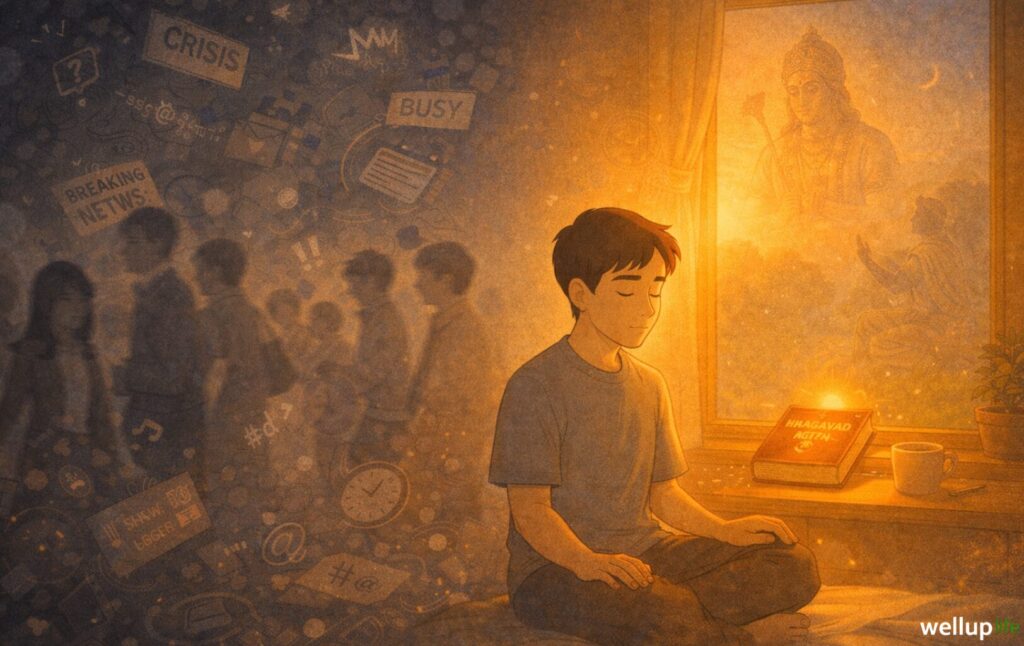
Indian philosophy looks at this experience differently. It suggests that mental exhaustion isn’t caused by life itself—but by how we live inside our minds. According to this view, the mind becomes tired not because it works hard, but because it never truly rests.
In this article, we’ll explore the real reason you feel mentally tired all the time through the lens of Indian philosophy. Not in a complicated or spiritual way—but in a deeply practical, relatable one that helps you understand what’s actually draining your mental energy—and what finally brings relief.
Physical tiredness is honest. When the body is exhausted, it clearly asks for rest—and once you give it sleep or relaxation, recovery begins. Mental fatigue, on the other hand, is confusing. You can sit still all day and still feel drained. You can rest physically and yet feel no sense of renewal.
The reason mental fatigue feels heavier is simple: the mind doesn’t stop working just because the body does.
When you’re physically tired, effort reduces. But when you’re mentally tired, effort often increases. Thoughts keep looping. Emotions replay themselves. Decisions—small ones—start feeling overwhelming. This constant inner activity quietly consumes energy.
Science supports this lived experience. Prolonged mental effort—such as continuous thinking, worrying, or decision-making—reduces the brain’s ability to regulate attention and motivation, leading to a deeper sense of exhaustion than physical effort alone SourceSustained cognitive effort leads to mental fatigue characterized by reduced motivation, impaired attention, and increased perceived effort .
Another reason mental fatigue feels worse is that it’s invisible. There’s no clear finish line. Physical work ends when the task ends. Mental work often continues long after the situation is over—replaying conversations, imagining outcomes, carrying emotional weight forward.
Indian philosophy recognized this long ago. It was observed that the mind doesn’t get tired because it thinks, but because it never pauses its movement. The body alternates between action and rest. The mind, unless consciously understood, rarely does.
That’s why mental fatigue feels suffocating. There’s no clear “off switch.” You’re tired, but the mind keeps talking. You want rest, but thoughts keep pulling you back in.
Understanding this difference is important—because it shifts the solution. If mental exhaustion were just about doing too much, rest would fix it. But if it’s about unceasing inner activity, then real relief requires a different kind of rest—one that Indian philosophy points toward.
Indian philosophy doesn’t describe the mind as tired because it works too hard. It describes it as tired because it never stops moving.
Ancient texts refer to the mind as chitta—not just thoughts, but the entire inner field where thinking, memory, imagination, emotion, and identity operate together. From this perspective, mental exhaustion happens when chitta is constantly disturbed by activity—what Indian philosophy calls vrittis, or mental movements.
These movements aren’t dramatic. They’re ordinary:
None of this looks like “work” from the outside. But internally, it’s relentless.
Indian thinkers observed something subtle yet powerful: the mind consumes energy not through effort alone, but through restlessness. A calm mind uses very little energy. A restless mind—jumping from one thought to another—uses a lot.
This is why mental fatigue can appear even on calm days. You may not be doing much externally, but internally, the mind is constantly engaged. Planning, comparing, worrying, remembering. From the Indian philosophy viewpoint, this uninterrupted mental motion is the real source of exhaustion.
One of the most important insights here is this:
The mind does not tire because of thoughts—it tires because it identifies with every thought.
When each thought feels personal, urgent, or meaningful, the mind stays tense. There’s no space. No pause. No release. Over time, this creates a background heaviness that we experience as “being mentally tired all the time.”
Indian philosophy doesn’t treat this as a disorder or weakness. It sees it as a habit of attention—a way the mind has learned to operate without rest.
And because it’s a habit, it can be understood. And when it’s understood, the mind naturally begins to slow down—not through force, but through clarity.
Most people believe mental exhaustion comes from thinking too much. So they try to stop thoughts, distract themselves, or force positivity. But Indian philosophy makes a surprising distinction: thinking itself isn’t the real issue.
The real drain comes from identifying with every thought.
Thoughts are natural. The mind is designed to think—just like the lungs are designed to breathe. Indian philosophy never treats thinking as an enemy. What it points out is something more subtle: when every thought feels like “me”, “my problem”, or “something I must solve right now”, the mind stays tense.
Imagine carrying a heavy bag. It’s manageable if you put it down sometimes. But if you believe you must hold it every moment, exhaustion is inevitable. Identification works the same way. When you carry every thought with you, there is no rest.
This is why overthinking feels exhausting—not because of the number of thoughts, but because of the emotional investment in them. Worry drains more energy than planning. Rumination drains more energy than action. Mentally replaying a situation often consumes more energy than actually dealing with it.
Psychology reflects this insight as well. Research on rumination shows that repetitive, self-focused thinking increases mental fatigue and emotional exhaustion, even without external stress SourceRepetitive self-focused thinking such as rumination is associated with increased mental fatigue and emotional exhaustion .
Indian philosophy frames this in a simple way:
Thoughts arise, but you are not required to become them.
When thoughts are observed rather than owned, their energy changes. They come and go without pulling the entire nervous system into action. But when the mind believes every thought is important, urgent, or personal, it stays in a constant state of readiness—and that readiness is tiring.
This explains something many people feel but can’t explain: even positive overthinking can be exhausting. Planning, self-improvement, and constant self-analysis—all of it drains energy when identification is present.
The shift Indian philosophy suggests is not control, but distance. Not suppression, but understanding. When identification loosens, thoughts lose their grip. And when thoughts lose their grip, mental fatigue begins to dissolve—not because life changes, but because your relationship with the mind does.
Next, we’ll explore another hidden drain most people overlook: the emotional weight we keep carrying forward without realizing it.
One of the biggest reasons mental tiredness lingers is something we rarely notice: we keep carrying emotional weight long after the moment has passed.
A conversation from the morning. A comment that didn’t sit right. A memory from years ago that still surfaces unexpectedly. Even when life looks calm on the outside, the mind is often busy holding onto unfinished emotional experiences.
Indian philosophy recognized this pattern early. It was observed that emotions don’t disappear just because a situation ends. When an emotion isn’t fully felt, understood, or released, it stays active in the background—quietly consuming mental energy.
This is what creates emotional carryover.
You may no longer be angry, but the body remembers the tension.
You may no longer be anxious, but the mind stays alert.
You may no longer be sad, but the emotional trace remains.
Psychology supports this experience. Research shows that unresolved emotional processing keeps the brain in a heightened state of arousal, which contributes to chronic mental fatigue and emotional exhaustion SourceUnprocessed emotional experiences can maintain physiological and cognitive arousal, contributing to sustained mental fatigue .
Indian philosophy explains this in a simple way: the mind doesn’t tire from new emotions—it tires from carrying old ones forward.
Every remembered emotion pulls attention back into the past or projects it into the future. This prevents the mind from resting in the present moment, where energy naturally replenishes. Instead, awareness stays split—partly here, partly somewhere else.
Over time, this creates a constant sense of heaviness. You’re not actively emotional, yet you feel drained. That’s because the mind is never fully at rest—it’s always holding something.
The important insight here is not to “let go” forcefully. Indian philosophy doesn’t suggest emotional suppression. It points toward allowing emotions to complete themselves—by noticing them fully without resistance or judgment.
When emotions are allowed to pass through awareness rather than being stored internally, the mind stops accumulating weight. And as the emotional load lightens, mental tiredness begins to ease naturally.
When mental tiredness sets in, most of us respond logically. We sleep more. Take breaks. Scroll. Watch something. Plan a vacation. Sometimes we even try to “fix” ourselves with productivity systems or motivation.
And to be fair, these things do help. Just not for very long.
The reason is simple: most modern solutions focus on changing what the mind is exposed to, not on how the mind operates.
Sleep rests the body and refreshes the brain, but it doesn’t automatically quiet mental patterns. Entertainment distracts the mind, but distraction isn’t the same as rest. Even vacations often come with mental baggage—planning, comparison, expectations—that follow us wherever we go.
Psychological research supports this distinction. Passive rest or distraction can temporarily reduce stress, but it does not significantly reduce ongoing mental fatigue if underlying thought patterns remain unchanged SourcePassive leisure activities may reduce stress temporarily but do not address the cognitive processes underlying chronic mental fatigue .
Indian philosophy anticipated this problem long ago. It was observed that a restless mind cannot be rested through stimulation, even pleasant stimulation. Whether it’s social media, entertainment, or constant self-improvement, the mind stays active, evaluating, reacting, and engaging.
Another reason modern solutions fall short is that they often treat mental exhaustion as a personal failure—something to overcome through discipline, optimization, or positive thinking. This creates more effort, not less. And effort, when the mind is already tired, adds to the fatigue.
From the Indian philosophy perspective, mental rest doesn’t come from doing something different—it comes from doing less internally. Not fewer activities, but fewer mental reactions. Not control, but understanding.
That’s why relief often arrives unexpectedly—in moments of stillness you didn’t plan. When the mind stops trying to fix itself. When attention softens. When awareness returns to the present without resistance.
Indian philosophy doesn’t respond to mental exhaustion by giving the mind more work. It doesn’t ask you to control thoughts, fix emotions, or become a better version of yourself.
It suggests something far simpler—and far more effective. Instead of managing the mind, it shifts attention away from the mind.
The core insight is this: mental fatigue reduces not when thoughts disappear, but when awareness is no longer trapped inside them. When attention rests in awareness itself, the mind naturally slows down without force.
This is why Indian philosophy emphasizes seeing rather than changing. Seeing thoughts as movements. Seeing emotions as temporary waves. Seeing the mind as something that appears within awareness, not something you have to wrestle with.
Ancient texts describe this as a return to the witnessing state—not in a mystical sense, but in a practical one. When thoughts are noticed without engagement, they lose urgency. When emotions are allowed without resistance, they complete themselves. The mind doesn’t need to be silenced; it needs to be understood.
This approach is radically different from modern mental strategies. There’s no constant self-monitoring. No forcing calm. No chasing positivity. Effort is replaced with clarity.
Modern neuroscience aligns with this insight. Studies on mindfulness and open awareness show reduced mental effort and improved emotional regulation when attention shifts from narrative thinking to present-moment awareness SourceMindfulness-based awareness reduces cognitive effort and improves emotional regulation by shifting attention away from narrative thought .
Indian philosophy also emphasizes simplicity in daily life. Not withdrawal—but non-entanglement. Doing what needs to be done without constantly replaying it mentally. Acting without dragging emotional commentary along.
This doesn’t make life passive. It makes it lighter.
Mental rest, from this perspective, is not something you schedule. It’s something that happens naturally when awareness is no longer consumed by mental noise.
This isn’t a routine. There’s no posture, no timing, and no requirement to sit quietly.
The shift is simple: notice when the mind is working unnecessarily—and stop adding yourself to it.
Throughout the day, the mind comments on everything. It evaluates, predicts, judges, and replays. Most of the time, this commentary isn’t required for action—it’s just habitual.
The shift is learning to recognize this moment:
“Thinking is happening, but I don’t need to participate.”
For example:
Nothing is wrong—but extra mental effort is happening.
Instead of stopping thoughts, Indian philosophy suggests stepping back into awareness. Let thoughts move on their own, without pushing them away or following them. The moment you stop identifying, the mental load reduces.
Neuroscience mirrors this effect. Studies show that when attention shifts from self-referential thinking to present-moment awareness, brain networks associated with mental fatigue and rumination become less active SourceShifting attention from self-referential thinking to present-moment awareness reduces rumination-related brain activity .
You may notice something subtle but important:
This is mental rest—not because the mind stopped, but because you stopped carrying it.
Practicing this doesn’t require effort. In fact, effort gets in the way. It’s more like remembering to put down a weight you didn’t realize you were holding.
Over time, this shift changes your relationship with mental activity. Thoughts still appear. Emotions still move. But they no longer drain the same energy—because awareness is no longer entangled in them.
Mental tiredness isn’t a personal failure. It’s not a sign that you’re weak, lazy, or incapable of handling life. From the lens of Indian philosophy, it’s simply a signal that the mind has been working without rest for too long.
Not because life is too demanding—but because attention has been constantly absorbed in thought, emotion, and inner commentary.
The relief you’re looking for doesn’t come from fixing yourself, optimizing your routine, or escaping life for a while. It comes from a gentler shift: learning to stop living inside the mind all the time.
Indian philosophy reminds us that rest isn’t something you earn—it’s something that naturally appears when awareness is no longer tangled in mental noise. When thoughts are allowed to arise and pass without ownership. When emotions are felt without being carried forward. When attention returns, again and again, to simple presence.
Mental fatigue fades not through force, but through understanding. And when that understanding settles, something quiet happens: the mind begins to rest on its own.