Physical Address
304 North Cardinal St.
Dorchester Center, MA 02124

Physical Address
304 North Cardinal St.
Dorchester Center, MA 02124
Written By:
Reviewed By:

Overthinking often feels like we’re being responsible — replaying conversations, imagining every possible outcome, trying to “figure it all out.” But instead of bringing clarity, it usually leaves us more tired, anxious, and stuck. Indian philosophy noticed this pattern thousands of years ago and came to a simple but powerful conclusion: a restless mind cannot see truth clearly. When the mind keeps circling the same thoughts, it moves away from wisdom, not toward it.
Ancient Indian texts don’t ask us to stop thinking altogether; they ask us to stop over-identifying with thought. From the Bhagavad Gita to the Upanishads, overthinking is described as mental noise that clouds perception and disconnects us from the present moment. According to this wisdom, real solutions arise from awareness, right action, and inner stillness — not from endlessly analyzing the same fears. This perspective feels especially relevant today, when the mind is rarely at rest and overthinking has become a modern habit disguised as problem-solving.
Ancient Indian texts understood overthinking not as intelligence, but as a mental imbalance. The Bhagavad Gita describes the mind as chanchala — restless, flickering, and difficult to control. When thoughts multiply without direction, they pull a person away from clarity and into confusion. Overthinking, in this view, is a sign that the mind is leading the person, instead of the person leading the mind.
For one who has conquered the mind, the mind is the best of friends; but for one who has failed to do so, the mind will be the greatest enemy.
 — Bhagavad Gita 6.6
The Upanishads go even deeper, explaining that most suffering comes from mistaken identification. We assume every thought is meaningful, personal, and urgent, when in reality, many thoughts are habitual reactions driven by fear, desire, or memory. By constantly engaging with these thoughts, we strengthen them. Yoga philosophy calls this cycle vritti — mental fluctuations that disturb inner peace.
Rather than encouraging endless analysis, ancient wisdom points toward awareness and restraint. The solution is not to fight thoughts, but to observe them without attachment. When attention is withdrawn from unnecessary thinking, the mind naturally becomes quieter. According to these texts, clarity is not something we create by thinking more — it is something that reveals itself when the mind settles.
Indian philosophy is clear on one thing: overthinking cannot solve problems because it operates from fear, not wisdom. When the mind overthinks, it moves away from reality and into imagination — replaying the past or worrying about futures that don’t yet exist. The Bhagavad Gita explains that such a mind becomes unstable, unable to see things as they truly are.
From a philosophical standpoint, overthinking strengthens maya — illusion. Instead of responding to life directly, we respond to mental projections. The more we think without awareness, the more we confuse thought with truth. This is why ancient sages emphasized viveka (discernment): knowing when thinking is useful and when it becomes self-created suffering.
Indian philosophy also teaches that clarity arises from stillness, not mental noise. A disturbed lake cannot reflect the moon clearly; in the same way, a restless mind cannot reflect wisdom. Solutions emerge naturally when the mind is calm and grounded. Overthinking delays action, weakens intuition, and exhausts inner energy — which is why, philosophically, it is seen not as problem-solving, but as resistance to reality.
In Indian philosophy, overthinking is closely tied to ahamkara — the ego sense that says “this thought is me, this problem is mine, I must control the outcome.” When the ego takes center stage, the mind becomes obsessed with protecting its identity, image, and expectations. Overthinking is not really about solving the problem; it is about protecting the ego from uncertainty, failure, or loss of control.
The Bhagavad Gita explains that suffering begins when the self identifies with thoughts, emotions, and outcomes rather than observing them with awareness. Once a thought becomes “my thought” or “my fear,” the mind keeps returning to it, trying to secure certainty where none exists. This is why overthinking feels personal and emotionally draining — the ego is deeply invested.
From a modern psychological perspective, this aligns with how excessive self-referential thinking works in the brain. Research shows that overthinking is associated with heightened activity in the Default Mode Network (DMN), the brain system linked to self-focused rumination and repetitive thought patterns SourceThe brain's default mode network and self-referential thought, Default Mode Network and Mental Health . When this network dominates, the mind loops around the self rather than engaging with reality.
Indian philosophy offers a simple but profound solution: disidentify from the ego. When thoughts are seen as passing events rather than extensions of the self, their emotional grip weakens. Overthinking loses power not because problems disappear, but because the ego is no longer demanding total control. In that space of humility and awareness, clarity — and often the right action — naturally arises.
When all desires that dwell in the heart fall away, then the mortal becomes immortal.
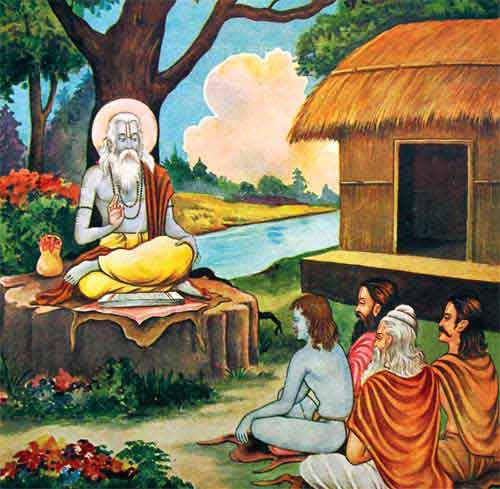 — Kathopanishad 2.3.14
Indian philosophy consistently favors conscious action over mental rumination, and Karma Yoga lies at the heart of this teaching. In the Bhagavad Gita, Krishna advises Arjuna to act according to his duty (dharma) without becoming mentally entangled in outcomes. Overthinking, in contrast, is seen as delayed action — the mind keeps planning, doubting, and imagining instead of moving forward.
Karma Yoga teaches that clarity emerges through action, not before it. When we overthink, we wait for perfect certainty, but Indian philosophy recognizes that certainty is rarely available at the mental level. Action performed with awareness breaks the loop of rumination and brings the mind back into the present moment. This is why the Gita emphasizes nishkama karma — action without attachment to results — as a path to inner peace and effectiveness.
Modern behavioral science supports this insight. Studies show that action-oriented approaches reduce rumination and anxiety, while excessive thinking increases stress and emotional fatigue SourceRumination, anxiety, and behavioral activation, Behavioral Activation and Rumination Reduction . Taking purposeful action shifts attention away from self-focused worry and toward engagement with reality.
From the perspective of Karma Yoga, overthinking is not wisdom — it is avoidance disguised as preparation. Right action, performed with presence and detachment, naturally quiets the mind. When action replaces rumination, the mind stops chasing imagined futures and begins responding intelligently to what is actually in front of us.
You have the right to perform your duty, but not to the fruits of action.
— Bhagavad Gita 2.47Indian philosophy approaches overthinking not as a mental disorder to be fixed, but as a spiritual imbalance to be understood. When the mind is disconnected from awareness, it clings to thoughts for security and control. Spiritual solutions work at a deeper level — not by managing thoughts, but by changing our relationship with them.
Rather than offering quick mental tricks, Indian wisdom points toward inner practices that quiet the mind naturally and restore balance. These teachings guide us away from compulsive thinking and toward clarity through awareness, detachment, and stillness. The following spiritual practices have been used for centuries to dissolve overthinking at its root, not just its symptoms.
Vairagya teaches us to engage fully with life without clinging to results. Overthinking is fueled by attachment to success, failure, approval, or control. When the mind becomes less attached to how things should turn out, it stops replaying possibilities endlessly. Indian philosophy explains that detachment weakens emotional reactions, allowing the mind to remain steady even in uncertainty.
A person who is not disturbed by happiness and distress and is steady in both is certainly eligible for liberation.
— Bhagavad Gita 2.15The Yoga Sutras emphasize abhyasa, steady and sincere practice, as essential for calming the mind. Overthinking does not disappear overnight; it fades as awareness is trained repeatedly. Through regular reflection, prayer, or meditation, the mind learns new patterns and gradually releases compulsive thinking.
Dhyana is the practice of observing thoughts without chasing them. Instead of suppressing thinking, meditation allows thoughts to rise and fall naturally. Scientific studies show that meditation reduces rumination and self-focused mental loops by quieting activity in brain networks associated with overthinking SourceMindfulness meditation reduces rumination, Effects of Mindfulness-Based Interventions on Rumination . As awareness deepens, mental noise naturally subsides.
Self-inquiry directly addresses the ego behind overthinking by gently asking, “Who is worried?” or “Who is thinking this thought?” Attention shifts from the problem to the observer. Advaita Vedanta teaches that when the thinker is examined, the grip of thoughts weakens. Overthinking loses its power when identity is no longer tied to mental activity.
Mauna refers to inner silence, not merely outer quiet. Indian sages taught that wisdom arises in stillness, not constant mental commentary. Practicing moments of silence — free from analysis and judgment — allows the mind to rest. In this space, clarity emerges naturally, without force or effort.
Eastern and Western traditions do not merely offer different techniques for mental health — they are based on different understandings of the mind itself. This is why overthinking is approached so differently in each system. One seeks to manage the mind; the other seeks to step back from it.
Western psychology generally treats the mind as the central problem and the central solution. Overthinking is seen as something that must be understood, analyzed, and corrected through conscious effort.
In this model, thoughts are considered meaningful signals that reveal underlying issues. Healing often involves exploring these thoughts, identifying patterns, and changing them.
Common features include:
This approach is effective for gaining insight and emotional vocabulary. However, for chronic overthinkers, repeated analysis can unintentionally keep attention locked inside the mind, reinforcing mental loops rather than dissolving them.
Eastern philosophies such as Yoga, Vedanta, and Buddhism begin with a radically different assumption: you are not the mind. Thoughts are seen as temporary movements within consciousness, not as the core of identity.
Overthinking, from this view, is not a defect — it is a habit of over-identification. Instead of fixing thought content, Eastern traditions train awareness to rest behind thought.
Key elements include:
Here, healing is not about replacing negative thoughts with positive ones, but realizing that no thought needs to be obeyed.
This shift — from engagement to observation — is where overthinking begins to dissolve.
| Aspect | Western Approach | Eastern Approach |
|---|---|---|
| View of Mind | Primary identity | Tool, not the self |
| View of Overthinking | Cognitive dysfunction | Ego-based attachment |
| Healing Method | Thought analysis and correction | Awareness and detachment |
| Role of Thoughts | Meaningful and actionable | Temporary and optional |
| Goal | Mental stability | Inner freedom |
| Result | Thought control | Thought transcendence |
Modern psychology increasingly acknowledges this wisdom. Mindfulness-based therapies combine Eastern awareness with Western structure and have been shown to reduce rumination and emotional reactivity SourceMindfulness-based interventions and rumination reduction, Mindfulness-Based Stress Reduction and Mental Health .
Western psychology helps us understand the mind.
Eastern philosophy helps us stop being trapped by it.
When combined, they offer a deeper truth:
Overthinking does not end when thoughts improve — it ends when awareness becomes stronger than thought.
You are the observer of thoughts, not the thoughts themselves.
— Mandukya UpanishadAncient Indian wisdom is deeply practical. It doesn’t ask you to withdraw from life or stop thinking altogether — it teaches you how to think less by living more consciously. The following practices are simple, grounded, and easy to apply in modern daily life, even amid stress and responsibilities.
Indian philosophy emphasizes awareness before reaction. When a thought arises, pause for a moment instead of immediately engaging with it. This small gap weakens the automatic loop of overthinking and brings you back to the present.
Modern neuroscience supports this: pausing activates regions of the brain linked to emotional regulation and reduces impulsive rumination SourceEmotion regulation and cognitive control, Neural mechanisms of emotion regulation .
Overthinking often revolves around why something happened. Ancient wisdom redirects attention toward right action in the present. Ask yourself: What is the next simple action I can take?
This reflects the principle of Karma Yoga — clarity follows action, not endless analysis. Behavioral studies show that action-focused thinking reduces anxiety and mental looping compared to rumination SourceBehavioral activation and reduction of rumination, Behavioral Activation for Depression .
Instead of fighting thoughts, observe them as passing events. Yoga philosophy calls this witnessing (sakshi bhava). Thoughts lose strength when they are seen rather than followed.
Mindfulness research confirms that observing thoughts without judgment significantly reduces rumination and emotional distress SourceMindfulness and reduced rumination, Effects of Mindfulness-Based Interventions on Rumination .
Much overthinking is driven by fear of results — failure, judgment, or loss. Practicing vairagya (detachment) means doing your best without mentally rehearsing every outcome.
Studies show that outcome fixation increases stress and cognitive overload, while acceptance-based approaches improve mental well-being SourceAcceptance and psychological flexibility, Acceptance and Commitment Therapy and Mental Health .
If you detach yourself from thoughts, you will discover peace.
 — Ashtavakra Gita
Ancient traditions valued mauna — intentional silence. Even a few minutes of quiet without mental input (no phone, no problem-solving) allows the mind to reset.
Research indicates that brief periods of silence lower mental fatigue and improve cognitive clarity SourceSilence and brain relaxation, Is Silence Golden? Effects of Silence on the Brain .
When caught in overthinking, gently ask: Who is the one thinking this thought? This practice of atma-vichara shifts attention from the problem to the observer, loosening ego identification.
Psychological studies on self-distancing show that observing thoughts from a detached perspective reduces emotional reactivity and repetitive thinking SourceSelf-distancing and emotional regulation, Self-Distancing and Emotional Well-Being .
You don’t need to solve life in your head.
You need to meet life as it unfolds.
Ancient wisdom reminds us that peace is not achieved by thinking better, but by knowing when thinking is no longer needed. Overthinking fades when awareness becomes more important than control.
Overthinking doesn’t always look the same. For some, it’s endless worry about the future; for others, it’s replaying the past or analyzing every tiny detail. Often, we don’t even realize how much mental energy we spend on our own thoughts.
This short quiz helps you uncover your overthinking intensity and style. In just a few minutes, you’ll see how your mind reacts to stress, uncertainty, and decisions — and which patterns quietly steal your peace.
There are no right or wrong answers. Simply choose what feels most natural to you. By the end, you’ll discover:
Take the quiz below and start understanding your mind instead of fighting it.
According to both Indian philosophy and modern psychology, overthinking is not a mental illness by itself, but a habitual pattern of the mind. Indian texts describe it as excessive mental fluctuation (vritti), while psychology links it to rumination — repetitive, self-focused thinking. When unchecked, it can contribute to anxiety and stress, but at its core, it is a learned mental habit that can be unlearned.
No. Indian philosophy does not promote the elimination of thought, but freedom from compulsive thinking. It values viveka (discernment) — knowing when thinking is useful and when it becomes harmful. The goal is not an empty mind, but a quiet, obedient mind that serves awareness rather than dominates it.
Problem-solving is purposeful and ends with action. Overthinking is repetitive and rarely leads to resolution. Indian philosophy draws this distinction clearly: thinking guided by awareness leads to clarity, while thinking driven by fear and ego (ahamkara) leads to mental exhaustion. Modern research also shows that rumination impairs decision-making rather than improving it.
Yes. Meditation helps by changing our relationship with thoughts, not by suppressing them. Scientific studies show that mindfulness and meditation reduce activity in brain networks associated with self-referential thinking and rumination. This directly aligns with ancient yogic teachings on mental stillness.
There is no fixed timeline. Indian philosophy emphasizes abhyasa — consistent practice — rather than quick results. Some people experience relief quickly, while deeper mental habits may take time to dissolve. Research on mindfulness-based practices shows that regular practice leads to gradual but lasting reductions in rumination and stress.
Indian philosophy reminds us of a simple but often forgotten truth: life is not meant to be lived inside the mind. Overthinking does not bring wisdom — it clouds it. The more we chase certainty through thought, the further we move from peace and clarity.
Ancient sages understood that the mind is a powerful tool, but a poor master. When guided by awareness, action, and detachment, it serves us well. When left unchecked, it creates suffering out of imagination. The solution is not to think harder, but to step back, observe, and act with presence.
In a world that constantly encourages mental noise, choosing stillness becomes a quiet form of strength. When awareness becomes deeper than thought, overthinking naturally fades — and in its place arises clarity, balance, and a sense of inner freedom that no amount of analysis can provide.
Do not dwell in the past, do not dream of the future, concentrate the mind on the present moment.
 — Gautama Buddha